
Oil after a sharp increase: correction or the beginning of a new decline?
The oil market was in an unusual situation. On the one hand, geopolitical risks and supply disruptions support high prices. On the other hand, the rising cost of fuel, the weakness of individual economies and the increase in US stocks force traders to take profits.
The WTI chart shows that after a long upward movement, the price formed a local high above $100 per barrel. Then the correction began, which led the quotes to the area of $95–96.
It is here that there are three levels that may be of interest to buyers.
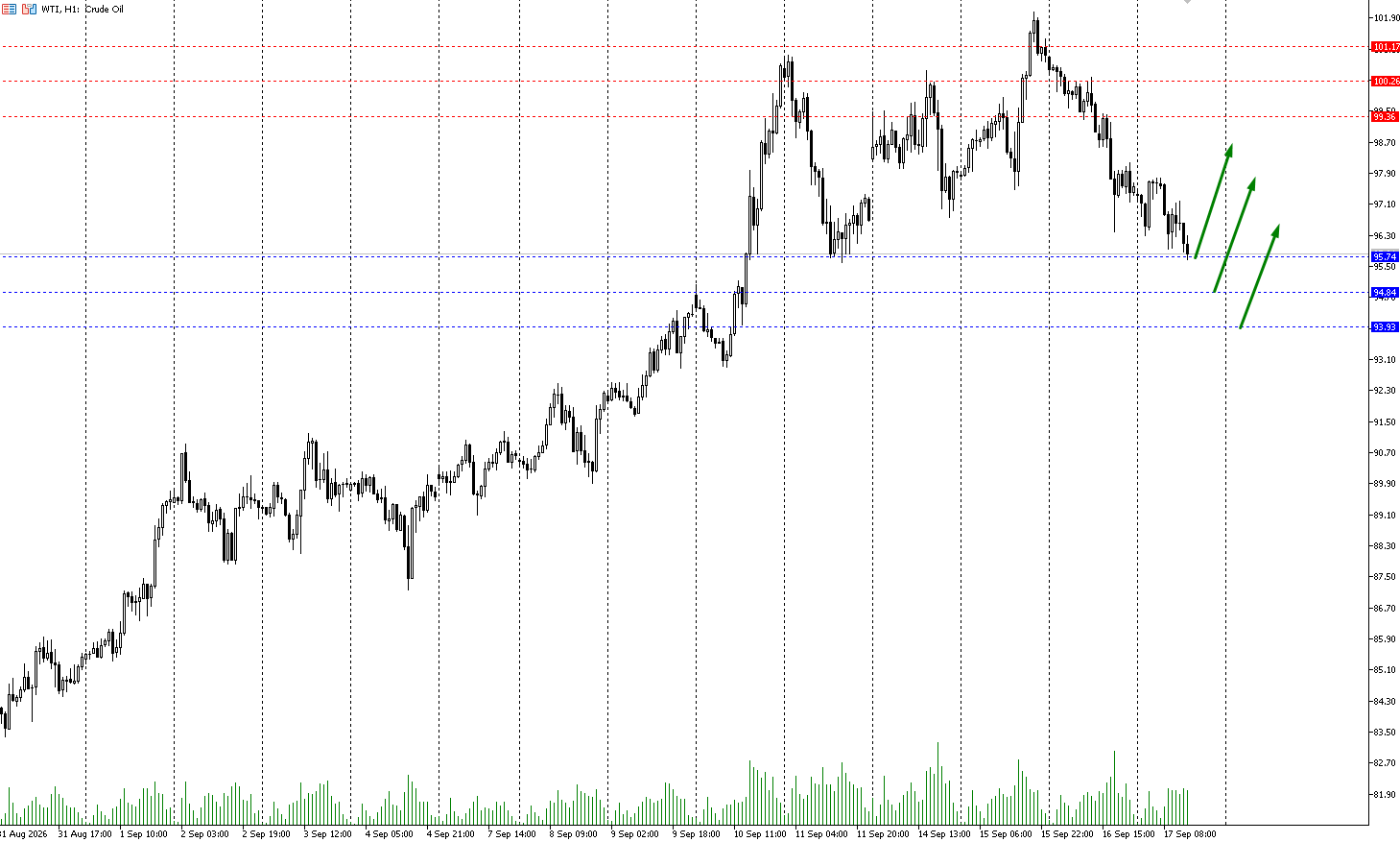
Potential WTI support areas at $95.74, $94.84, and $93.93 per barrel.
Three levels of potential buyer interest
1. Level 95.74
This is the closest support area located near the current correction area.
The price has already demonstrated several times the ability to hold in the area of this value after a strong impulse growth. For buyers, this level can be the first observation point.
If quotes stabilize above 95.74 and a reversal appears on the junior timeframes, the market may try to recover some of the recent decline.
However, simply touching a level is not a confirmation of a reversal. It is important to assess the reaction of candles, volumes and dynamics of the US dollar.
2. Level 94.84
The second zone is located below and represents a deeper correction.
If the sellers manage to push 95.74, the attention of the market may shift to 94.84. Such a scenario would mean that buyers are not ready to defend immediate support, but the medium-term upward momentum will not necessarily be broken yet.
This level may be especially interesting when the price drops sharply amid short-term panic or news of a temporary recovery in supplies.
3. Level 93.93
The lower blue mark is the deepest area of the three levels considered.
Its importance is important from the point of view of the chart structure: here is the area from which the acceleration of growth previously developed. If the price returns to 93.93, the market will be able to check how strong the previous demand was.
For buyers, this is no longer just an attempt to catch a small pullback, but a potential area for the formation of a larger position. At the same time, the probability of increased volatility is also higher here.
Why Oil Still Gets Support
Geopolitics limits supply
The main fundamental factor of the oil market is now associated not only with consumption, but also with the physical availability of raw materials.
In September, disruptions to oil infrastructure and attacks on supply routes heightened fears of a decline in exports from the Middle East. Reuters reported that Brent and WTI prices rose above $100 per barrel amid attacks on tankers and threats to oil logistics.
Later, some concerns eased after reports of the redirection of Saudi supplies through Oman and the possible restoration of individual export routes. This was one of the reasons for the current correction.
But the decline in the geopolitical premium does not mean that the market automatically returns to its previous equilibrium. As long as risks to infrastructure and maritime transport remain, market participants will lay additional compensation for uncertainty.
US Inventory: Temporary Relief for Sellers
Another factor of pressure on oil is associated with American reserves.
U.S. commercial crude oil inventories declined by about 640,000 barrels in the week ending September 11, according to the EIA. However, the decline turned out to be less than analysts' expectations. At the same time, stocks of gasoline and distillates increased.
This is an important signal for the market.If US domestic supply recovers faster than expected and demand for refined products slows, short-term pressure on WTI could intensify.
However, inventories need to be considered together with exports, refinery loading and the state of international logistics. One report does not determine the long-term direction of the market.
Demand is declining, but supply shortages remain a risk
The oil market is facing two opposing trends at the same time.
Weakness of demand:
high fuel prices reduce consumption;
expensive loans limit business activity;
the slowdown in China's economy is putting pressure on industrial demand;
high interest rates raise the risk of a global slowdown.
Offer limitation:
disruptions in the Middle East;
attacks on oil infrastructure;
difficulties with sea transportation;
reduction of individual production capacities;
insufficient speed of recovery of supplies.
The International Energy Agency has previously indicated that the global market could face a significant decline in supply in 2026 due to conflicts and disruptions in the Gulf region. At the same time, demand was also revised downwards, which makes the market balance particularly sensitive to new data.
This is how the WTI scenario can develop
Scenario 1: 95.74 rebound
If the price holds the nearest level and forms a reversal candlestick structure, the first benchmark of recovery may be the zone of recent local resistance.
Such a scenario would mean that the correction gradually loses strength, and buyers begin to control the short-term movement again.
Scenario 2: Deeper pullback to 94.84
A breakout of 95.74 does not necessarily mean a change in the global trend.
In this case, the market can move on to testing the second zone. For buyers, such a scenario could create a more favorable risk/reward ratio if the level is confirmed by the price reaction.
Scenario 3 - 93.93 Test
If seller pressure intensifies due to rising inventories, a stronger dollar, or a lower geopolitical premium, the price may head toward lower support.
Around 93.93, it is especially important to carefully assess the fundamental background. If the market continues to receive negative news on demand and at the same time sees a recovery in supply, the support may be temporary.
What can change the oil picture
Before opening a position, you should track not only the chart itself, but also several macroeconomic factors:
eIA reports on oil and petroleum product inventories in the United States;
oPEC+ production decisions;
news about supplies from Saudi Arabia and other Gulf countries;
the situation around the Strait of Hormuz and the Red Sea;
the dynamics of the US dollar;
data on the Chinese economy;
uS bond yields;
iEA and OPEC forecasts for global demand.
The reaction of oil to news that at first glance is not related to energy is especially important. For example, rising bond yields and a stronger dollar can simultaneously worsen conditions for commodities, even if the physical shortage of oil persists.
Practical conclusion for traders
On the current schedule, the most important areas for observation remain:
Level | Purpose |
|---|---|
95,74 | Immediate support and the first zone of buyers' reaction |
94,84 | The average zone of potential interest when continuing the correction |
93,93 | Lower support and area of deeper demand testing |
Buying from the level makes sense only if there is confirmation of the market reaction. Do not take any blue mark as a guarantee of a reversal: the price can break through support against the backdrop of strong fundamental news.
For risk management, it is important to determine in advance the size of the position, the allowable loss and the conditions for canceling the scenario.
TRADE OIL AND OTHER GLOBAL ASSETS AT AVORA MARKETS
Registering with Avora Markets allows you to access trading in financial instruments and independently apply technical analysis, support levels and macroeconomic data in your trading strategy.
Main conclusion
WTI is in an area where technical correction meets fundamental uncertainty.
Three levels on the chart, 95.74, 94.84 and 93.93, allow you to determine in advance the areas in which the interest of buyers may appear. At the same time, oil remains dependent on geopolitics, American reserves, Chinese demand and the state of the global economy.
The main question for the market now is not only how deep the price will roll back, but whether the supply shortage will persist after the normalization of individual supplies.
If supply remains tight, the current correction could become part of a broader upward movement.If supplies recover quickly and global demand continues to weaken, the pressure on oil prices may increase.