The market, which until recently was waiting for the Fed to soften its policy, received a completely different signal.
Kevin Warsh spoke at Jackson Hole for the first time as head of the central bank and actually put the fight against inflation above investors' expectations for lower rates.
The main indicator remains problematic:PCE reached 3.7%, while the Fed's target is 2%. At the same time, the six-month inflation rate is even higher — about 4.1%.
The market is again laying the groundwork for an increase
After Warsh's speech, the likelihood of a rate hike at the September meeting rose sharply.
Before the performance, the market estimated it at about 35%, after — about60%. Recent quotes indicate a probability in the region of 60–62%.
This completely changes the picture for those who were counting on an early easing of monetary policy.
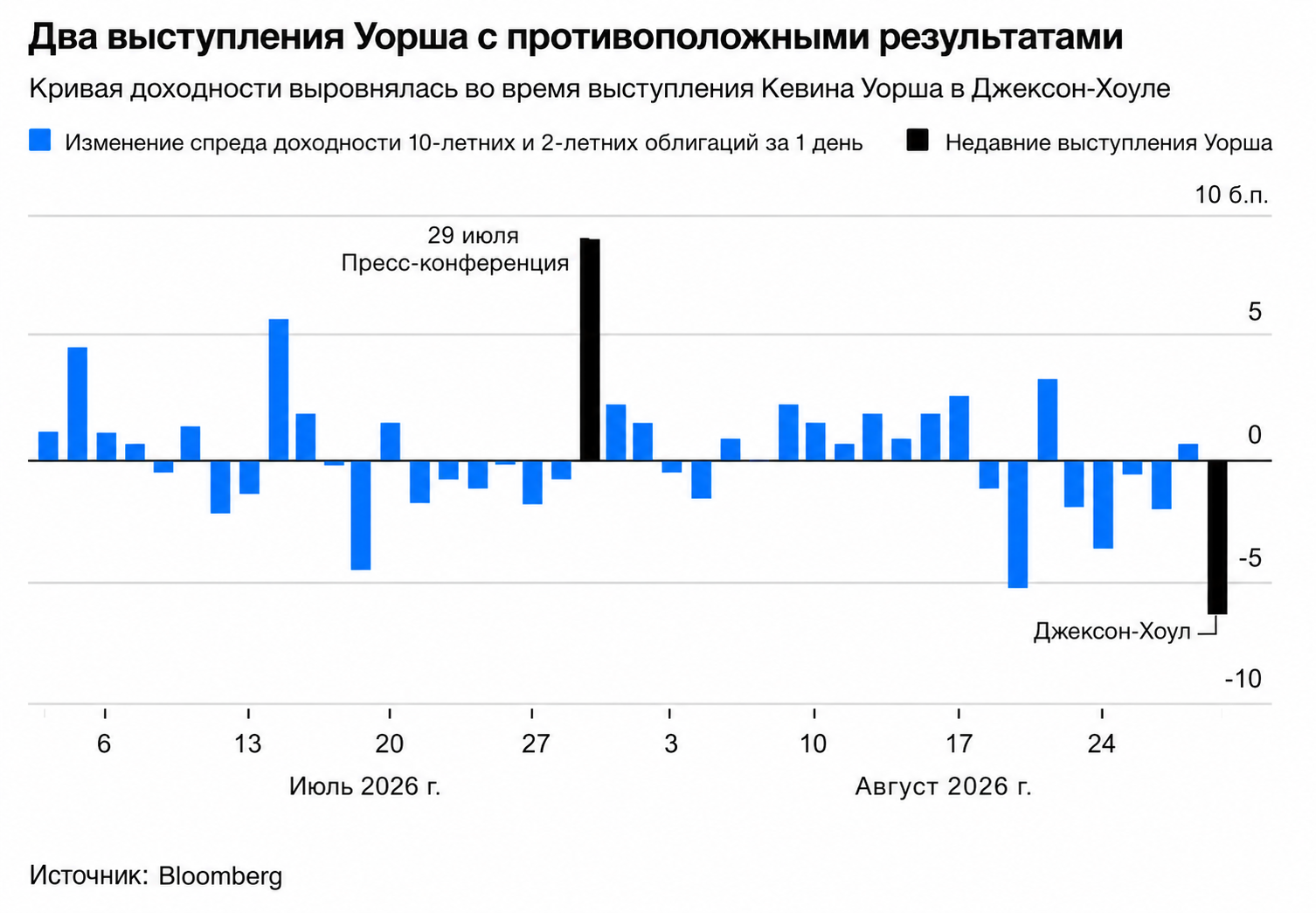
The reaction of Treasury bond yields to Kevin Warsh's speeches. After Jackson Hole, yields at the short end of the curve rose and the curve flattened markedly. Source: Bloomberg.
Why Warsh is rigid
The head of the Fed believes that the US economy remains quite strong.
Corporate investment growth accelerated, consumer spending remained robust, and unemployment was around 4.1%. At the same time, Warsh noted that the financial conditions cannot yet be called truly restrictive.
Therefore, he does not yet see any grounds for a rapid reduction in rates.
Moreover, Barclays already expectstwo rate hikes in 2026 — in September and December.
What flattening of the curve means
The reaction of bonds is particularly interesting.
The yield on two-year Treasuries has risen, as it is the short end that is most sensitive to the Fed's expectations.
At the same time, long yields moved weaker. As a result, the yield curve flattens.
This is a signal that the market is simultaneously layingtighter Fed now and more limited potential for rate growth in the long run.
Main conclusion
The September rate no longer looks like an obvious pause.
Now the market is waiting for new data on employment and inflation, which can finally determine the Fed's decision.
For stocks, gold and cryptocurrencies, this means one thing:volatility may increase markedly.