
For a long time, private credit was considered one of the most stable parts of the financial market.
Investors received high yields, companies — access to capital without resorting to traditional banks.
But the era of expensive money begins to change the situation.
In the private credit segment, the first serious signs of tension appear.
Problem loans are growing
Proportion of loans with the statusnon-accruingthe 20 largest public BDCs rose to2,8%— the highest level since 2017.
For one quarter, the indicator increased by about0.8 percentage points.
This means that more and more borrowers are experiencing problems with debt servicing.
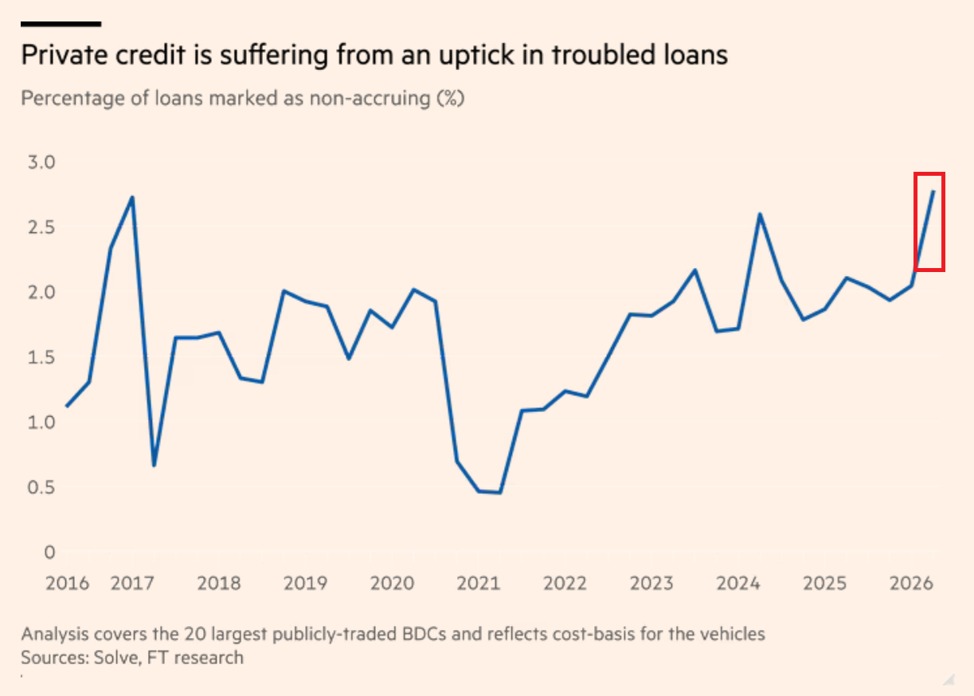
The share of problem loans in the portfolios of the largest public BDCs. In 2026, the indicator reached its highest level since 2017. Source: Solve, FT Research.
Why private credit is under attack
The main reason is high interest rates.
Most loans in private credit have a floating rate.
When the Fed raises the value of money, companies almost immediately face rising interest costs.
For a strong business, this is simply an increase in costs.
But for companies with a high debt burden, the situation becomes much more complicated.
The result is a chain:
high rates → more expensive debt service → reduced profits → increased risk of defaults.
The market grew too fast
In recent years, private credit has grown into a market with a volume of about$2 trillion.
Investors were attracted by the high yields and the ability to earn premiums higher than traditional bonds.
But rapid growth always creates new risks.
When the economy slows down, weak borrowers begin to appear in such segments.
Is this a new financial crisis?
It is too early to talk about a systemic crisis.
Private credit differs from the banking sector in that most of the risk lies with institutional investors rather than depository banks.
But the scale of the market makes it important for the entire financial system.
If defaults continue to rise, this could lead to:
reducing investors' appetite for risk;
tightening lending conditions;
pressure on companies with high debt loads.
Main conclusion
Private credit has long been one of the big winners in the high-stakes era.
But now those same high returns are becoming a source of risk.
The increase in problem loans shows that the pressure from expensive money is gradually starting to reach the end borrowers.
The main question now is whether there will be a local correction in the quality of loans or the beginning of a larger cycle of problem debt.