
Sulfur is one of those resources that most people never think about. But it is at the heart of supply chains related to fertilizers, food and mining of a range of critical metals.
In 2026, this invisible part of the global industry was under pressure from several sides at once.
Strait of Hormuz, through which about half of the world's seaborne sulfur trade passes, has become a major logistical bottleneck. Russia has extended restrictions on the export of industrial sulfur until the end of 2026. At the same time, China has restricted exports of sulfuric acid, an important product of sulfur processing.
This is no longer just a story about an industrial chemical that has risen in price.
The problem is that sulfur is in several critical chains at once: from the production of phosphate fertilizers to the acid leaching of copper, nickel and cobalt.
And that is why a local shortage of raw materials can have a much wider economic effect.
Briefly about the main things
~50%the world's seaborne sulfur trade usually passes through the Strait of Hormuz.
~25%world's sulfur is produced in the Middle East.
7.5 million tonnes— estimated sulfur production in Russia in 2025 against approximately84 million tonnesin the world.
Russia extends ban on export of certain types of industrial sulfuruntil December 31, 2026.
In the first half of 2026, exports of sulphuric acid from China fell sharply; according to IFPRI, the volume decreased from 2.19 million tonnes a year earlier to 784 thousand tonnes.
What is happening in the sulfur market?
The main feature of the sulfur market is that a significant part of it is not produced specifically for the sake of sulfur itself.
It is a byproduct of oil and natural gas refining, especially when working with high-sulfur feedstocks. Therefore, the supply depends not only on the demand for sulfur, but also on the processes in the energy sector.
This is what makes the market less flexible.
If the demand for fertilizers or metals increases sharply, producers cannot simply increase sulfur output instantaneously in the same way as the production of a conventional manufactured good.
In 2026, the geopolitical factor was added to this structural feature. S&P Global
estimates that the Middle East typically accounts for nearly half of the world's seaborne sulfur trade, with Strait of Hormuz being a key route for these shipments.
When traffic through Hormuz was disrupted, the problem quickly spread beyond the region.
Why is sulfuric acid important here?
Sulfur itself is just the beginning of the chain.
One of the most important products of its use issulphuric acid (H₂SOᐈ).
It is used to produce phosphoric acid, which is then used in the production of phosphate fertilizers. Sulfuric acid is also needed to leach some ores and is used in the chemical industry, oil refining, metal processing, and other processes.
In other words:
Sulfur → Sulfuric Acid → Fertilizers / Metals / Chemicals
That is why sulfur disruptions can extend far beyond the sulfur market itself.
Strike on fertilizers is already a food issue
This is where the most sensitive part of the story comes in.
Phosphate fertilizers require sulfuric acid to process phosphate feedstock. Therefore, sulfur deficiency can increase the cost of fertilizer production even in countries that do not directly import sulfur themselves.
But there is a broader dependency.
Our World in Data estimates that synthetic nitrogen fertilizers produced using the Haber-Bosch process provide nutrition for about half of the world's population. At the same time, the researchers themselves emphasize that it is impossible to separate the contribution of fertilizers from other factors — plant breeding, irrigation, mechanization and agricultural technologies — with absolute accuracy.
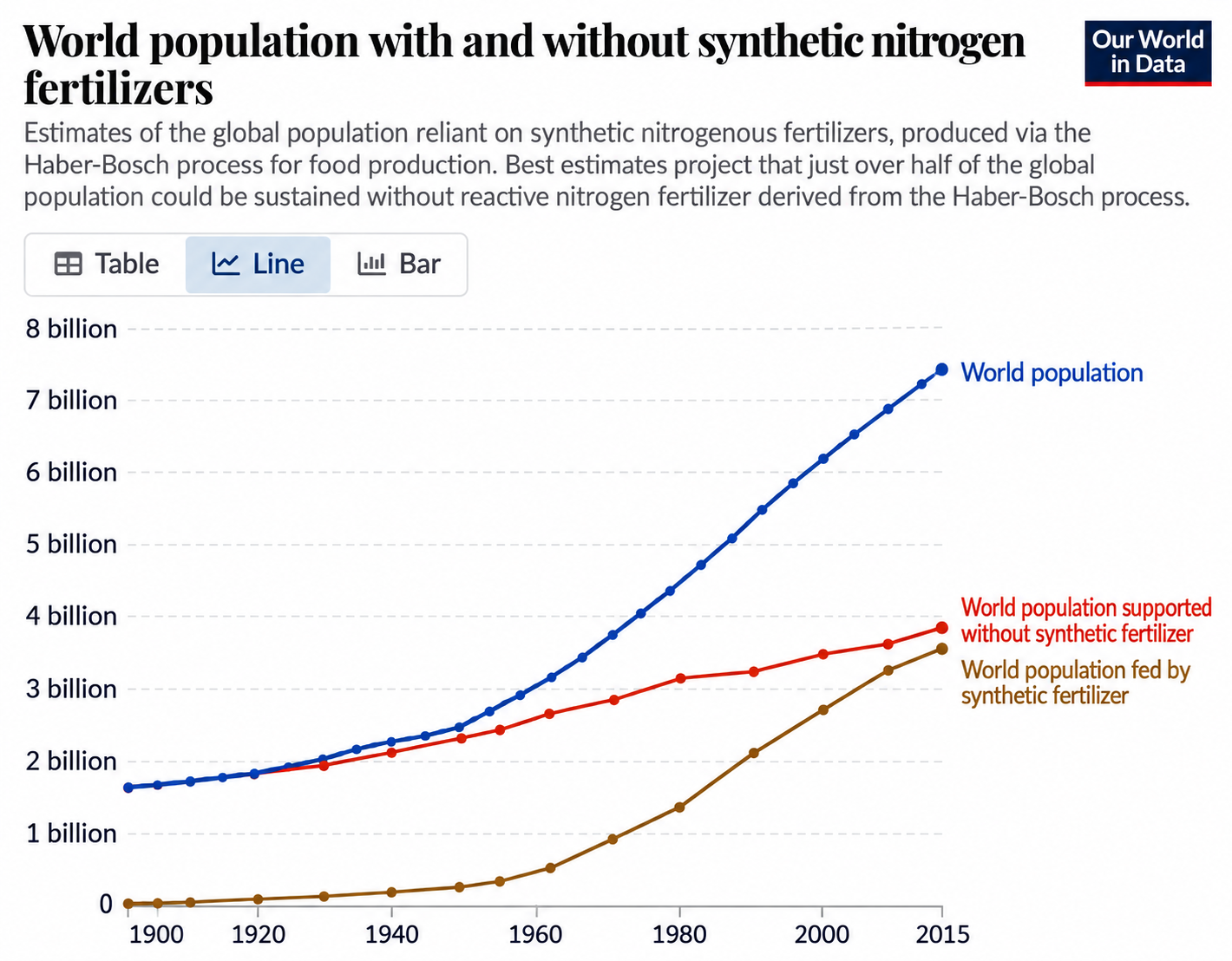
This does not mean that sulfur deficiency will automatically lead to food shortages.
There is a long chain between the price of raw materials and the final harvest: fertilizer producers have reserves, can change sources of supply, and farmers and states can adapt.
But the longer the shortage of raw materials persists, the higher the likelihood that increased costs will begin to be transferred further along the chain.
That is why the fertilizer market should be considered as one of the main indicators of the development of the sulfur crisis.
The second front — copper, nickel and other critical metals
Food is only one side of the problem.
Sulfuric acid is used in ore leaching processes, including the production of copper, nickel and cobalt.
This is especially important for deposits where hydrometallurgical processes are an essential part of production.
The IEA explicitly notes that sulfur is a key feedstock for sulfuric acid, which is needed for both fertilizer production and the processing of critical minerals such as copper, lithium, cobalt, nickel, and rare earths. The agency also notes that the rising cost of acid has already increased production costs in some critical mineral chains.
This creates an unusual situation.
Investors usually focus on the metals themselves — copper, nickel, cobalt or lithium.
But there is a long chain of chemical reagents between the mine and the final metal.
If one of them becomes scarce, the growth of production of the metal itself may be economically more difficult.
Example of copper
Reuters reported in April that China had stopped supplying sulfuric acid to Chile and was then preparing for further export restrictions.For Chile, this is particularly sensitive: sulfuric acid is used in the process of leaching copper ore, and the country is the largest copper producer in the world.
This is a good example of how the problem of one chemical raw material can gradually turn into a problem of a completely different market.
Russia: proposal becomes more state-run
Russia is another important element of the picture.
According to the USGS, Russia produced about 7.5 million tons of sulfur in 2025 with global production of about 84 million tons.
At the same time, the Russian government extended the temporary ban on the export of certain types of industrial sulfur from July 1 to December 31, 2026. The restriction applies to liquid, granular and lumpy sulfur, with a number of exceptions.The official goal is to provide raw materials for domestic production of mineral fertilizers and food security.
This is an important point for market analysis.
When a major producer restricts exports, the global supply does not necessarily disappear physically. Part of the material simply changes the direction of movement — from the international market to the domestic one.
For the domestic consumer, this can increase the sustainability of supplies.
For the foreign market — to reduce the available volume.
That is why export restrictions can increase price pressure even without the complete physical disappearance of production.
China: the difference between sulfuric acid and sulfuric acid is important
Here it is necessary to separate two different markets.
Elemental sulfurandsulfuric acid— not the same thing.
China is practically not a significant exporter of elemental sulfur, but the country is the largest producer of sulfuric acid. In May 2026, China restricted sulfuric acid exports amid market tensions. IFPRI notes that Chinese acid exports fell from 2.19 million tons in the first half of 2025 to 784 thousand tons a year later.
Reuters separately reported that China previously supplied a significant part of the sulfuric acid for the Chilean market, and the cessation of these supplies created additional pressure on the country's copper industry.
Therefore, the phrase “China has banned the export of sulfur” can be misleading.
It is much more accurate to talk aboutrestrictions on the export of sulfuric acid.
For the global industry, the effect of this can be no less significant.
Why the crisis can spread along the chain
The main risk is not in one particular product.
It looks something like this:
Hormuz / export restrictions
↓
Less sulfur available to international buyers
↓
Higher sulfur prices
↓
Higher sulfuric acid costs
↓
More expensive fertilizers + metal processing
↓
Higher production costs
↓
Pressure on agricultural and industrial supply chains
It is this chain that makes sulfur interesting for macroanalysis.
It connects markets, which are usually considered separately.
Fertilizer futures can react to one factor, copper to another, and sulfur prices to a third.
But physically, all three markets may be bound by the same restriction.
Prices already show tension
The rise in prices for sulfur and sulfuric acid began even before the entire chain of restrictions was fully manifested.
S&P Global noted in May that the price of CFR US Gulf sulfuric acid reached $400 per ton against $155 before the outbreak of the military conflict at the end of February. The fob US Gulf sulfur price reached $1,060 per ton against $650 at the time of the launch of the corresponding price indicator in early April.In Brazil, the sulfur estimate reached $1,150 per ton versus $525 before the conflict.
Another industry source, AVEVA, noted an even larger increase in sulfur prices over two years. The difference in estimates is explained by the measurement period and a specific price benchmark.
Therefore, not one specific figure is more important here, but the direction of movement:
the market ceased to perceive sulfur as a cheap and almost invisible by-product.
What to track now?
1. Strait of Hormuz
This is the main logistics factor for the sulfur market.
If normal vessel traffic is restored, part of the physical deficit may gradually go away. But S&P Global noted that even after the transit is restored, the normalization of supply chains could take months.
2. Export restrictions of Russia
It should be monitored whether the Russian restriction will remain until the end of 2026 and whether the conditions for exceptions will be changed.
3. Chinese export of sulfuric acid
This is particularly important for the copper, nickel and other metals markets using acid leaching.
4. Prices for sulfur and sulfuric acid
If physical availability remains limited, prices may continue to signal tension before it becomes noticeable in the final goods.
5. Prices for phosphate fertilizers
The increase in the cost of raw materials can be gradually transferred to the cost of fertiliz
6. Copper and nickel production
Here it is important to look not only at the price of metal, but also at the cost and availability of the necessary reagents.
7. New export restrictions
2026 has already shown how quickly the restrictions of one country can change global commodity flows. The WTO notes that various countries imposed restrictions on sulfur, sulfuric acid and other components of the fertilizer chain in 2026.
Main conclusion
The sulfur crisis is interesting not because sulfur itself is the largest market.
On the contrary.
Its meaning is determined by thehow many other markets depend on this inconspicuous raw material.
Sulfur connects energy with the chemical industry. Sulfuric acid links the chemical industry to fertilizers and the mining sector. And fertilizers and metal mining are already directly related to food and industrial production.
In 2026, several factors encountered at the same time: restriction of the key sea route, export restrictions of Russia, reduction of Chinese exports of sulfuric acid and high demand from the fertilizer and metallurgical industries.
It is too early to turn this into a forecast of a global shortage of food or metals.
But the market is already showing thatsulphur can no longer be regarded as a secondary industrial commodity.
For investors and analysts, this is another example of how a real bottleneck is sometimes not in the final raw material, but at one of the inconspicuous intermediate stages of its production.