
AI is facing a $4.9 trillion revenue shortfall: will infrastructure investments be worth it?
The AI boom faces a financial challenge that could change investor attitudes toward the tech sector.
According to the estimates presented, data center owners will need about $8.5 trillion in revenue until 2030 to cover investment costs and ensure a return on invested capital (ROIC) of 12%. However, current forecasts suggest receiving only $3.6 trillion.
The difference is $4.9 trillion.
This does not mean that the industry is guaranteed to incur losses of this amount. We are talking about the gap between the revenue necessary to justify large-scale investments under given conditions of profitability and current forecasts.
A fundamental question arises: is the AI industry building infrastructure faster than business can turn this technology into a sustainable source of income?
The problem goes far beyond the technology sector. It affects corporate profitability, capital allocation, economic performance, and the outlook for the U.S. stock market.
Scale of the problem: $8.5 trillion vs. $3.6 trillion
To understand the scale of the financial contradiction, it is enough to compare three key figures:
$8.5 trillion is the necessary revenue until 2030 to cover investments and achieve a return on invested capital of 12%.
$3.6 trillion - projected revenue for the same period.
$4.9 trillion is the difference between the required and expected level of revenue.
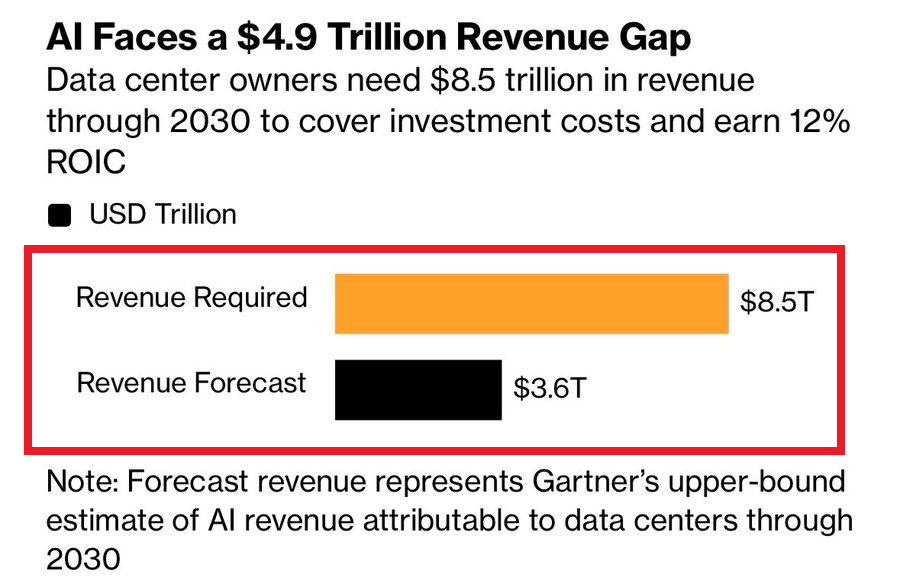
This estimate of projected revenue is based on the upper bound of Gartner's forecast for data center-related AI revenues through 2030.
It is important to understand: $4.9 trillion is not a forecast of direct losses. This is the difference between the financial requirements for infrastructure investments and the expected revenue.
Nevertheless, the scale of this gap shows how high financial expectations accompany the current expansion of AI infrastructure.
Why does artificial intelligence need so much money?
The development of artificial intelligence requires much more than just the creation of software.
Behind each language model, chatbot or automated service is a complex infrastructure, including:
Data centers and server complexes.
High-performance graphics processors (GPUs).
Electricity and cooling systems.
Network equipment.
Data storage and processing systems.
Continuous maintenance and updating of equipment.
All of these components require a significant initial investment.
Unlike the traditional software business, where the increase in the number of users is not always accompanied by a comparable increase in infrastructure costs, the development of AI directly depends on computing power.
The higher the demand for AI services, the more resources are needed to process requests, train models, and maintain the infrastructure.
However, there is an economic contradiction here: investments are made today, while the revenue that should justify them is expected in the future.
Therefore, it is important for investors to assess not only the pace of the spread of artificial intelligence, but also the ability of companies to turn this demand into sustainable cash flows.
Performance issue: tech giants vs. the rest of the market
Another important point is that the economic benefits of AI development are distributed extremely unevenly.
According to the data presented, revenue per employee and profitability are growing mainly among companies from the Magnificent 7 group. At the same time, the remaining 493 companies of the S&P 500 Index show almost no noticeable progress.
This is a fundamental difference between companies that create and commercialize AI infrastructure and businesses that predominantly consume the relevant services.
For the largest technology corporations, artificial intelligence can become a new source of income thanks to cloud computing, software subscriptions, equipment and specialized services.
For other companies, the economic situation looks different.
They pay for the use of AI tokens, computing power and software solutions, but the resulting tools do not always lead to comparable revenue growth or a reduction in operating costs.
As a result, artificial intelligence can turn from a tool for improving efficiency into an additional item of expenditure.
This is where one of the main questions of the current investment cycle arises: how broadly does the economic benefit of AI extend beyond the largest technology companies?
Why rising AI spending doesn't guarantee profit growth
Large-scale investments in themselves do not mean high returns.
Companies can devote billions of dollars to building infrastructure, but still have difficulty generating sufficient commercial returns.
There are several main risks.
1. Infrastructure grows faster than monetization
The construction of data centers requires huge initial costs.
If the demand for computing power increases more slowly than expected, infrastructure owners may face the problem of expensive assets that do not bring enough revenue.
2. Monetization of AI services remains a challenge
An increase in the number of users does not necessarily mean a proportional increase in profits.
Companies can attract millions of customers while incurring significant computational costs every time they interact with their AI products.
Cost-effectiveness depends on whether customers are willing to pay enough to cover these costs and ensure sustainable margins.
3. Productivity growth remains uneven
If companies outside the tech sector fail to turn AI adoption into measurable efficiency gains, their willingness to increase spending on such solutions may decline.
In the future, this may affect the demand for AI infrastructure and computing power.
4. The scale of investment increases the requirements for financial results
The more capital is invested in infrastructure development, the higher revenue and profit are needed to justify these investments.
If the expected return is not realized, investors can revise the estimates of companies whose growth prospects largely depend on the further expansion of the artificial intelligence market.
How might this affect the stock market?
The investment cycle around artificial intelligence has become one of the important components of the overall history of the growth of the American stock market.
Technology companies are supported by expectations of robust AI demand, infrastructure expansion, and future productivity gains.
However, the growing gap between required investments and projected revenue poses additional risks.
If companies continue to increase capital expenditures without comparable revenue growth, the market may start to rethink the sustainability of their business models.
Several segments deserve special attention:
Semiconductor manufacturers: The demand for AI equipment is closely tied to investments in data centers.
Cloud providers: The most important factor is the ability to turn the demand for computing into regular revenue and operating profit.
Data center operators: Their profitability depends on capacity utilization, service costs, operating costs, and long-term demand. S&P 500
companies. Spreading the benefits of AI can affect the dynamics of corporate profits. Highly rated
technology companies. Expectations of future profitability may become more sensitive to disappointing financial results.
At the same time, the revenue gap does not mean that a stock market correction is inevitable.
It only forces investors to carefully distinguish between companies that already earn on the development of AI and businesses that have yet to prove the economic efficiency of their investments.
What indicators should investors monitor?
The next stage in the development of the AI industry will depend on how successfully infrastructure investments turn into real financial results.
Five indicators deserve special attention.
1. Growth in revenue from AI products
It is important to monitor whether products and services based on artificial intelligence bring significant regular revenue, and not just increase the number of users and the computational load.
2. Capital expenditures of the largest technology companies
Continued growth in infrastructure investment needs to be weighed against revenue and profit dynamics.
3. Operating margin
If the introduction of AI really improves productivity, over time this should be reflected in the financial results of companies.
4. Revenue per employee
This indicator helps to assess how effectively companies use labor resources and whether they are able to generate more economic value with the help of new technologies.
5. Utilization of data centers and profitability of infrastructure
The ability to turn installed computing power into real-world revenue will be critical to justify large-scale investment.
Taken together, these indicators will help to understand whether the industry is moving towards sustainable profitability or gradually accumulating financial risks.
The main question is: will AI be able to justify the cost of its own development?
Artificial intelligence is able to change entire industries, automate processes and create completely new business models.
However, technological progress and financial profitability are not the same thing.
The current investment cycle is based on the assumption that future demand will justify today's massive infrastructure spending.
The $4.9 trillion gap underscores the uncertainty of this assumption.
If the spread of AI leads to a substantial increase in revenue and productivity across the economy, today's investments may ultimately prove worthwhile.
But if monetization remains predominantly concentrated in the hands of a small group of technology corporations, and the rest of the business cannot achieve a noticeable increase in efficiency, the economic model of the current boom will become much more difficult to justify.
For financial markets, the main question of the next stage of AI development may no longer be how powerful this technology will become.
It's about how much money she can really make.