
Hedge funds have invested $1.7 trillion in US bonds. Why this is important for the whole market
The US government bond market has long been considered one of the deepest and most liquid financial markets in the world.
But the structure of demand for it is gradually changing.
According to the data presented on the Bloomberg and Federal Reserve chart,american hedge funds purchased about $1.7 trillion of US Treasuries between 2022 and 2025.
During this time, their share of the circulating U.S. national debt has grown from about4% to almost 9%and the total amount of Treasury bonds on their balance sheets reached about$2.7 trillion by the end of 2025.
At first glance, this may look like an ordinary story about large investors buying American debt.
But there is an important detail.
A significant part of this demand is not due to the classical rate on the growth of the price of bonds, but to the so-called basis trade — a strategy that uses the difference between the Treasuries market and futures on them.
And this is where a much more interesting story begins.
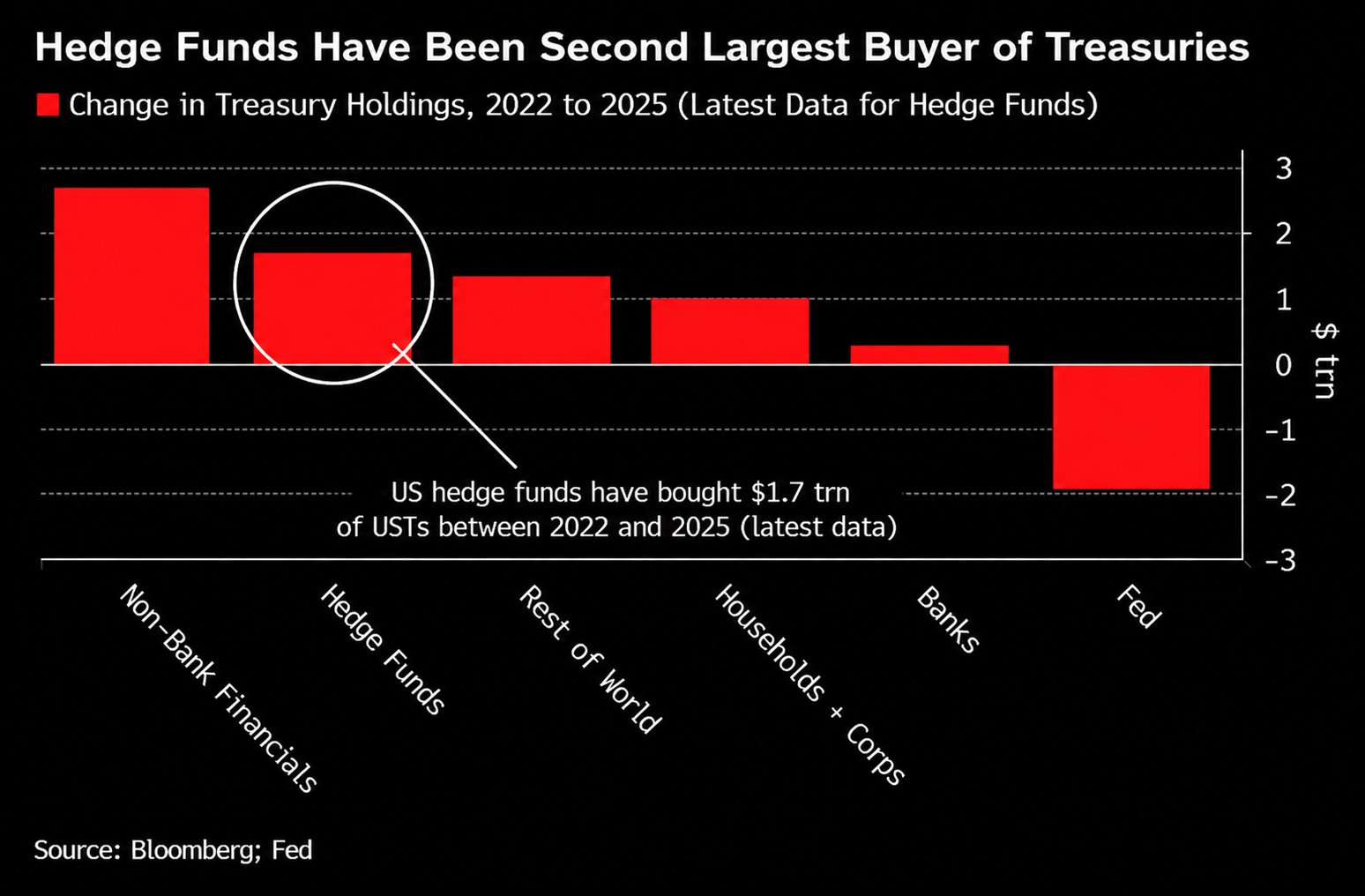
Hedge funds have become one of the largest buyers of US Treasuries. According to Bloomberg and the Federal Reserve, their purchases in 2022–2025 amounted to about $1.7 trillion.
What is happening in the US debt market
To understand the scale of what is happening, you first need to look at the market itself.
The US regularly borrows money through the issuance of Treasury bills, notes and bonds. These instruments are used by the state to finance budget expenditures and refinance existing debt.
The buyers are banks, funds, foreign governments, insurance companies, pension funds, private investors and other financial institutions.
However, in recent years, hedge funds have become increasingly visible in this system.
Their presence is particularly interesting because they can employ significantly more sophisticated strategies and leverage than traditional long-term investors.
As a result, a hedge fund can buy Treasury bonds not because it expects to simply capitalize on their growth.
His task may be completely different.
What is basis trade and what does it have to do with $1.7 trillion
Basis tradeis a strategy that tries to make money on a small difference between the price of a physical Treasury and the corresponding futures.
The simplified scheme is as follows:
Buying Treasury is a → simultaneous short position in the futures → fixing the difference between the two markets.
On one trade, the potential difference may be small.
But hedge funds work with huge volumes.
Therefore, even a small price inefficiency can become interesting if you use a large amount of capital and leverage.
And here comes the key factor:
Scale.
If the fund makes such a transaction for billions of dollars, even a small difference in price can give a significant financial result.
That is why the growth of hedge fund positions in Treasuries cannot be interpreted simply as a classic purchase of American debt.
It's part of a much larger financial market infrastructure.
Why Hedge Funds Have Become So Important Buyers of Treasuries
There are several reasons.
First, the U.S. government debt market has tremendous liquidity.
Secondly, Treasury is used in a huge number of financial transactions.
Third, the difference between the bond market and the futures market can create opportunities for arbitrage strategies.
And most importantly —the scale of the market itself allows you to build positions worth tens and hundreds of billions of dollars.
According to the data presented in the provided chart, from 2022 to 2025, hedge funds increased their investments in US Treasuries by about$1.7 trillion.
This is no longer a secondary participant.
This is a significant source of demand and liquidity.
But here comes the problem
Large positions in themselves do not mean a problem.
The problem arises when a significant part of these positions is built using leverage.
Let's imagine the situation:
The yield of Treasuries begins to rise sharply.
This means a drop in the price of bonds.
For a long-term investor, this situation can be unpleasant, but not necessarily critical.
A hedge fund with a large leveraged position is in a completely different situation.
If the market movement becomes strong enough, the fund may face:
requirements to increase collateral;
margin calls;
the need to quickly find additional liquidity;
reduction of positions;
forced closure of part of the transactions.
And then a potentially dangerous chain arises.
Rising yields → pressure on leveraged positions → need to attract liquidity → sale of assets → additional pressure on the market.
Why this can be a problem for more than just bonds
This is where the story becomes interesting for all investors.
If large funds are forced to downsize rapidly, they may need to do more than just sell Treasuries.
They can reduce positions in other assets as well.
This could potentially affect:
shares → bonds → currencies → commodity assets → credit instruments → other highly liquid positions.
Therefore, the problem of liquidity in one market can spread much further.
This is one of the reasons why the structure of the Treasuries market is closely monitored not only by bond traders, but also by macroinvestors.
Most importantly, who is the buyer of American debt today?
The data provided shows an interesting picture.
Among the largest categories of Treasuries buyers for the period under review are:
non-bank financial institutions;
hedge funds;
other market participants;
households and corporations;
banks.
At the same time, the Federal Reserve, according to the presented data, on the contrary, reduced its holdings.
And this is an important point.
When the structure of demand changes, so does the market's resilience to strong movements.
If a significant part of the demand is provided by investors with a long-term horizon, their behavior with rising yields may be very different from the behavior of leveraged hedge funds.
$2.7 trillion is a figure worth remembering
By the end of 2025, the volume of Treasury held by hedge funds reached approximately$2.7 trillion.
At the same time, their share in the marketable US government debt increased from about4% to almost 9%.
This means that hedge funds have become a much more prominent participant in the American debt market.
And here comes the main question:
What happens if some of these positions start to unfold at the same time?
This does not mean that such a scenario will necessarily occur.
But the concentration of capital itself makes this question important for assessing market risk.
What this means for investors
For an ordinary investor, the main thing here is not to remember the termbasis trade.
The main thing is to understand the mechanics.
Today's financial markets are much more connected than they seem.
The same large financial structure can simultaneously have positions in:
government bonds;
futures;
shares;
currency;
credit instruments;
other derivatives.
Therefore, a sharp change in the cost of funding or Treasury yields can force market participants to reconsider positions in several asset classes at once.
That is why American Treasuries are not just a bond market.
It is one of the central nodes of the global financial system.
Why Treasury should be monitored especially closely now
There are several indicators that make it possible to understand whether the tension is increasing:
1. Yield of US Treasuries
A sharp movement in yields can quickly change the value of leveraged positions.
2. Bond Volatility
The stronger the fluctuations, the higher the collateral requirements and the more difficult it is to maintain large positions.
3. Market liquidity
If bid-ask spreads expand and the depth of the market decreases, it becomes more difficult to close large positions without a significant impact on the price.
4. Positioning of hedge funds
Changing futures positioning can show how much market participants use such strategies.
5. Monetary conditions
The cost of financing is critical for strategies based on small price differences.
And here begins the most interesting
The main risk is not that hedge funds own Treasuries.
The risk is a combination of three factors: large position volume + leverage + a sharp change in market conditions.
As long as the strategy works, it can add liquidity to the market.
But with a strong movement, the reverse process occurs.
Participants begin to close positions at the same time.
That is why the concentration of leveraged positions can become a source of systemic risk.
What this could mean for other markets
This is especially important for a trader.
If the US bond market begins to experience severe stress, the reaction may appear in other instruments.
Attention should be paid to:
USD
The dollar may respond to changes in expectations for rates and demand for American assets.
Gold
Gold is sensitive to real returns, the dollar, and the demand for defensive assets.
US indices
The S&P 500, Nasdaq, and other stock indices may respond to changes in the cost of capital and Treasury yields.
Crypto
Bitcoin and Ethereum can also sense changes in global liquidity and appetite for risk.
That is why the analysis of the Treasury market is useful even for a person who has never bought American bonds.
What should an investor do?
You should not take this story as a signal to “sell everything”.
Data on hedge fund purchasesdo not automatically meanthat the market is on the verge of collapse.
But they show an important structural feature of the modern financial market:
a huge amount of capital is inside strategies, where a small price difference turns into a significant financial result due to scale and leverage.
Therefore, it makes sense for investors to follow not only the direction of the S&P 500, Bitcoin or gold.
Sometimes the answer to a question“why is the market moving so sharply?”is in a completely different place.
For example, in the US government bond market.
Want to observe the market yourself?
If you want not just to read macro-analysis, butobserve the movement of key global assets in real time, you can open a trading account atAvora Markets.
Depending on the availability of tools for your region, traders can use the platform to work with various financial markets and test their trading ideas.
For those who want to understand the platform and trading mechanics first, it is availabledemo account, which allows you to try your strategies without using real funds.
👉 Open a demo account with Avora Markets and test your trading ideas
And what if you want to start with a real account?
There is an offer for new customers of Avora Markets:
50% bonus on first deposit and 10% bonus on subsequent deposits— on the terms of the program and subject to its rules.
This may be of interest to those who already understand the risks of trading and want to receive additional conditions when replenishing the account.
👉 Sign up for Avora Markets and get information about a 50% bonus on your first deposit
Bonus programs have conditions and restrictions. Before use, you must familiarize yourself with the current terms of the offer.
Essentials in 30 seconds
If time is short, here's what to keep in mind:
$1.7 trillion— about as many Treasuries, according to the data presented, were bought by American hedge funds in 2022–2025.
$2.7 trillion— the approximate amount of Treasury on their balance sheets by the end of 2025.
~4% → ~9%— an increase in their share in the marketable US government debt.
Basis trade— one of the reasons for this demand.
Leverageis the main factor that turns a normal market movement into a potential liquidity problem.
That is why the US Treasuries market is worth keeping an eye on even those who trade stocks, gold, currencies or cryptocurrencies.