
Gold below $4,000: why the threat of a new escalation around Iran has brought down prices
Gold fell below $4,000 per troy ounce for the first time since the beginning of 2026. For a market that is traditionally perceived as a haven in times of geopolitical instability, such a move seems unexpected.
However, the current situation has its own peculiarity.Investors are assessing not only the likelihood of a new military confrontation around Iran, but also its potential consequences for the oil market.
The main risk is a possible spike in oil prices if airstrikes resume. If this happens, the energy shock could change inflation expectations, increase concerns about interest rates and affect demand for gold.
Thus, the market is now reacting not so much to the geopolitical conflict itself, but to the possible economic chain of consequences.
This explains the unusual dynamics of two key commodity assets: oil shows stability, while gold is under serious pressure.
What happened to the gold?
On October 30, 2026, gold fell below $4,000 per troy ounce. This is the first such decline since the beginning of the year.
The presented chart clearly shows the discrepancy between the dynamics of Brent and gold.
While Brent crude has fluctuated widely and moved higher in recent months, gold has been gradually losing ground. By the end of October, its price had dropped to about $3,900.
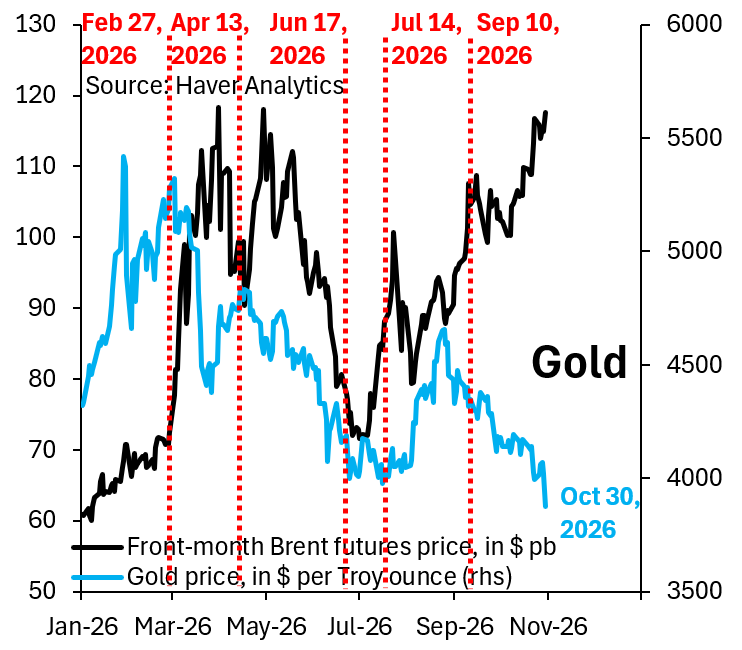
The graph shows the dynamics of Brent oil futures with the nearest delivery date and the price of gold per troy ounce during 2026.The red vertical lines mark the key dates: February 27, April 13, June 17, July 14 and September 10.
Data source: Haver Analytics.
It is especially important that gold’s decline occurs against the backdrop of ongoing geopolitical uncertainty.
Under normal circumstances, such an environment could support demand for defensive assets. But now investors are taking into account an additional factor - the potential impact of military escalation on energy prices.
Why does the situation around Iran affect gold?
Iran occupies a strategically important position in the global energy market. Any major escalation around the country could heighten concerns about oil supplies and the stability of the region's energy infrastructure.
For financial markets, this creates several interrelated risks.
1. Possible jump in oil prices
If airstrikes on Iran resume, market participants may begin to price in an increased likelihood of oil supply disruptions.
Even without an actual reduction in export volumes, expectations of possible problems can increase the so-called geopolitical premium in the value of Brent.
This means investors are starting to pay more for oil given the potential risks to future supply.
2. Energy inflation
More expensive oil could spread inflationary pressures far beyond the energy sector.
Rising fuel costs increase transportation, production and logistics costs. Over time, some of these costs can translate into prices for goods and services.
For central banks, this creates a difficult situation: even if economic growth slows, accelerating inflation may limit the scope for monetary policy easing.
3. Changes in interest rate expectations
If the oil shock increases inflation fears, the market may revise expectations for future Federal Reserve policy.
Tighter interest rate expectations could put additional pressure on gold.
The reason is the opportunity cost of owning the precious metal. Gold does not generate interest income, so as the attractiveness of interest-bearing instruments increases, its relative competitiveness may decrease.
This is where an important paradox arises: geopolitical risk can both support gold as a safe haven asset and put pressure on it through energy inflation and interest rates.
Why isn't gold rising amid the geopolitical threat?
The common idea of gold as an asset that necessarily rises in price during military conflicts oversimplifies the real picture.
Gold reacts not only to political events. Its cost depends on a combination of factors:
Real interest rates.
US dollar dynamics.
Inflation expectations.
Demand for protective assets.
Investment flows.
Overall liquidity of the financial system.
In the current situation, the interaction between the oil and interest markets is of particular importance.
If geopolitical tensions cause oil to rise, investors may begin to fear new inflationary pressures. This, in turn, could support expectations of higher rates and reduce the attractiveness of gold.
Therefore, the fall of the precious metal does not necessarily mean the disappearance of demand for defensive assets.
Perhaps the market is simply assessing the potential consequences of conflict through a different mechanism.
What could happen to gold next?
The key factor for further dynamics will be the development of the situation around Iran.
Now we can distinguish three main scenarios.
Scenario 1: Geopolitical tensions ease
If the threat of renewed airstrikes subsides and concerns about oil supplies begin to subside, the geopolitical premium on oil prices could narrow.
In this case, inflationary concerns associated with the energy market may ease.
This could improve the conditions for gold's recovery, especially if interest rates and the dollar stop adding pressure.
Scenario 2: Military escalation intensifies
The resumption of airstrikes could trigger a new wave of uncertainty in the oil market.
If Brent rises sharply, investors will have to assess the likelihood of a new inflationary impulse.
For gold, the result may be mixed: traditional demand for safe haven assets will compete with pressure from interest rates and the dollar.
Scenario 3. The conflict drags on
Prolonged uncertainty could make the oil market more sensitive to any news about supplies and energy infrastructure.
In such a situation, gold may show increased volatility, and its future direction will depend on which factor turns out to be stronger: demand for capital protection or changes in monetary policy expectations.
What should investors watch now?
To understand whether gold's decline is a temporary reaction or the start of a longer move, it's worth keeping an eye on several indicators.
1. Brent Crude Oil
The main indicator of the geopolitical premium in the oil market.
The sharp acceleration in Brent's rise could indicate increased concerns about future supplies.
2. US Dollar Index (DXY)
The index shows the dynamics of the dollar against a basket of major currencies.
A stronger dollar could put additional pressure on gold as the metal becomes more expensive for buyers in other currencies.
3. US Treasury yield
The dynamics of US government bond yields is especially important.
Their growth can increase the opportunity cost of owning gold and reduce the attractiveness of an asset that does not generate interest income.
4. US real interest rates
This is one of the most important macroeconomic factors for the gold market.
If real rates continue to rise, the precious metal could come under additional pressure. Their reduction, on the contrary, can improve conditions for the recovery of quotes.
5. News around Iran
In the short term, it is the development of the geopolitical situation that can become the main catalyst for the movement of oil and related financial markets.
It is important to monitor not only the statements of the parties, but also the actual developments of events.
Main conclusion
The fall of gold below $4,000 per troy ounce was an important event for the commodity market in 2026.
But the most interesting part of this story lies not in the psychological mark itself, but in the mechanism of what is happening.
The market fears that renewed hostilities around Iran could lead to a sharp rise in oil prices. Such a scenario could increase inflation expectations and change investors' views about the future policies of central banks.
As a result, gold came under pressure at a time when it would traditionally have benefited from geopolitical uncertainty.
If current tensions ease and oil risks begin to fade away from market expectations, gold may be in a position to recover.
However, it would be premature to expect an automatic refund above $4,000. This will require assessing not only the developments around Iran, but also the reaction of the dollar, bond yields and real interest rates.
Follow global market movements and key macroeconomic events with AVORA MARKETS.