
Yields are rising simultaneously around the world
A rare picture for recent years is emerging on the global bond market: investors are simultaneously reducing positions in government securities of the largest economies.
According to the data presented, the Japanese 10-year bond yield reached around3%. In the US, yields are at their highest levels since 2007, and in the UK, Germany and other developed countries there are also multi-year peaks.
The distribution of yields on the chart shows that what is happening is not a local problem of one country. The market demands higher compensation for holding government debt in several regions at once.
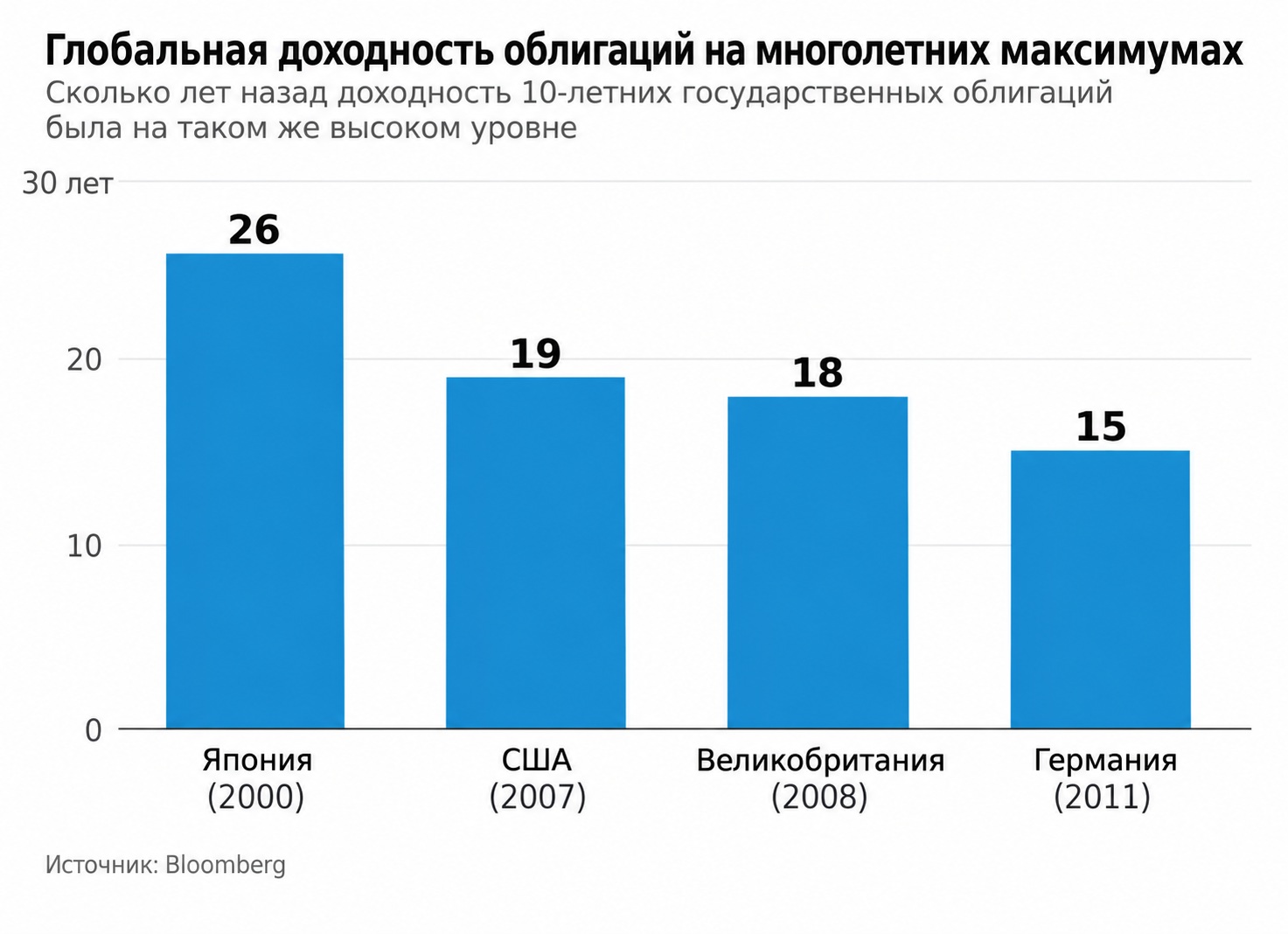
10-year government bond yields have reached levels previously seen during major inflation and debt cycles.
In early September, Reuters noted that the yield on 10-year Japanese bonds rose to 3% for the first time since 1996. At the same time, the yields on British and German securities reached levels not seen in more than ten years.
Why investors are selling government bonds
An increase in yield means a decrease in the price of bonds already issued.The higher the rate that the market demands from the government, the cheaper old issues with a fixed coupon become.
The main reasons for the current movement can be divided into four groups.
1. Inflation is becoming an important factor again
High energy prices, geopolitical risks and rising logistics costs are fueling concerns about future inflation.
If investors believe inflation will persist longer than expected, they demand a higher nominal yield. Otherwise, the real purchasing power of future bond payments will decline.
As a result, the market is beginning to price in tighter monetary policy and higher rates for the long haul.
2.Government debt is no longer perceived as almost free
The last decade has been characterized by extremely low interest rates and massive bond purchases by central banks.
This policy supported the price of government securities and allowed governments to borrow relatively cheaply. However, now the situation is changing.
Governments have to refinance old debts at higher yields.The greater the volume of borrowing, the greater the impact of rates on the budget.
In the United States, the public debt has exceeded $40 trillion, and the cost of servicing obligations is becoming an increasingly prominent part of budget expenditures.
3. Central banks are no longer absolute buyers
After a period of quantitative easing, central banks gradually shrink their balance sheets and are less likely to be the main source of demand for long-term bonds.
This means that the market needs to find new buyers. If private investors, banks, pension funds and foreign reserves are not willing to absorb the entire volume of new issues, the issuer has to offer a higher yield.
This is how a self-sustaining process arises:
more borrowing → more supply of bonds → higher required return → more expensive debt servicing.
4. Japan is changing the global structure of capital flows
The Japanese market has long been one of the main sources of cheap financing for the global economy.
With rates at almost zero, Japanese investors actively allocated capital abroad, buying American, European and Australian bonds.
But if the yield on Japanese government securities continues to rise, some capital may gradually return to Japan.
This could reduce demand for foreign debt and put further pressure on yields in the US, Europe and other developed markets. Reuters called this a potential regime change for the global fixed income market.
Why is this important for the stock market?
Government bond yields are considered the benchmark for valuing most financial assets.
As yields on risk-free instruments rise, investors begin to reconsider the attractiveness of stocks, real estate, technology companies and other assets.
Particularly sensitive are companies whose value depends on future cash flows.The higher the discount rate, the lower the present value of the profits that the company will receive in a few years.
This is why rising yields can create pressure on:
technology stocks;
growth companies;
highly valued stock indices;
real estate market;
investment projects with a large amount of borrowed capital;
cryptocurrencies and other risky assets.
However, the market reaction is not always the same. If rising yields are linked to a strong economy, stocks may remain resilient. If the cause is inflation, budget problems and decreased liquidity, the pressure on risky assets increases.
What's happening with the dollar, gold and cryptocurrencies
The synchronized rise in yields is creating a challenging environment for all asset classes.
US dollar
Higher US bond yields could support dollar demand, especially if the market expects further tightening from the Federal Reserve.
But excessive increases in yields could simultaneously increase concerns about the sustainability of US government debt. Therefore, the reaction of the foreign exchange market depends not only on the rate, but also on confidence in fiscal policy.
Gold
Gold is traditionally sensitive to real bond yields. If real rates rise, the opportunity cost of holding gold increases.
On the other hand, gold may receive support from inflation risks, geopolitical uncertainty and central bank demand for safe haven assets.
Bitcoin
For cryptocurrencies, the rise in the global cost of money means a reduction in available liquidity and an increase in investor risk requirements.
Bitcoin can react particularly sharply because its price depends largely on capital inflows, monetary policy expectations and investors' appetite for volatile assets.
At the same time, the cryptocurrency market remains a separate segment and does not always move in sync with bonds.
Main Risk: Debt Spiral
The most important question is not whether the yield on a particular issue has reached an all-time high.
Something else is much more important:Are governments able to continue borrowing at the same rate at new interest rates?
If debt service costs rise faster than tax revenues and economic growth, fiscal pressure increases.
Possible consequences:
reduction in government spending;
tax increases;
additional issue of bonds;
pressure on central banks to ease policy;
rising inflation expectations;
further revaluation of financial assets.
That's why the current bond selloff may not be a short-term move, but part of a longer-term shift in the financial regime.
What investors should watch in the coming weeks
To understand the direction of global markets, it is worth monitoring several indicators at once:
US 10-year bond yield;
the yield of Japanese JGBs;
the difference between nominal and real yield;
expectations for Fed and ECB rates;
volumes of government borrowings;
inflation and oil prices;
demand at government bond auctions;
dollar dynamics;
capital flows into stocks, gold and cryptocurrencies.
Special attention should be paid to the behavior of long bonds. If yields are rising at the long end of the curve, this could indicate not only expectations for central bank rates, but also a rise in long-term inflation premiums and fiscal risks.
Conclusion
The global bond market is entering a period where the high cost of money is becoming a risk factor in its own right.
Japan, the US, the UK and Europe are simultaneously facing rising yields. This means that investors are demanding greater compensation for holding government debt, and governments are being forced to consider new financing conditions.
This is an important signal for financial markets: the era of virtually free capital is gradually giving way to an environment where the cost of money again determines the price of assets.
Monitoring such changes is especially important for traders working with currencies, indices, gold, oil and cryptocurrencies.