
Fed Increases Treasury Bills to $554 Billion: Why the Balance Rises After a Rate Increase
The Federal Reserve is simultaneously doing two things that at first glance do not go well with each other.
On the one hand,On September 16, 2026, the Fed raised the target federal rate range by 25 basis points to 3.75-4.00%On the other hand, the Federal Reserve continues to increase the volume of short-term Treasury Bills on its balance sheet.
As of September 23, the volume of U.S. Treasury Bills directly owned by Fed reached$554.373 billion. At the beginning of December 2025, the figure was about $195.5 billion. That is, in less than a year, the volume increased by about$359 billion.
This is a really big change.
But here it is important not to fall into the trap of the simple phrase “Fed prints money again like during COVID”.
The mechanism today is different.
Fed calls these operationsReserve Management Purchases — RMP, that is, purchases to manage the reserves of the banking system. Their task is to maintain a sufficient level of reserves and maintain control over short-term rates, and not to stimulate the economy through the massive purchase of long-term bonds.
And this is where a more interesting story begins.
Briefly about the main things
$554.4 billion
— the volume of U.S. Treasury Bills on the Fed's balance sheet as of September 23, 2026.
+$358.9 billion
— approximate increase from the level of $195.5 billion in early December 2025 to the current $554.4 billion.
3,75–4,00%
— the current target range of the federal rate after the September 16 hike.
$38 billion + $25 billion
— volumes of Treasury buyback operations provided for the current quarter for liquidity support and cash management, respectively.
$500 billion
— almost as much Treasury has already bought out as part of the entire buybacks program over the past two and a half years, according to US Under Secretary of the Treasury Francis Brook.
What happens to Treasury Bills on Fed's balance?
Here is the graph that best shows the scale of the change.
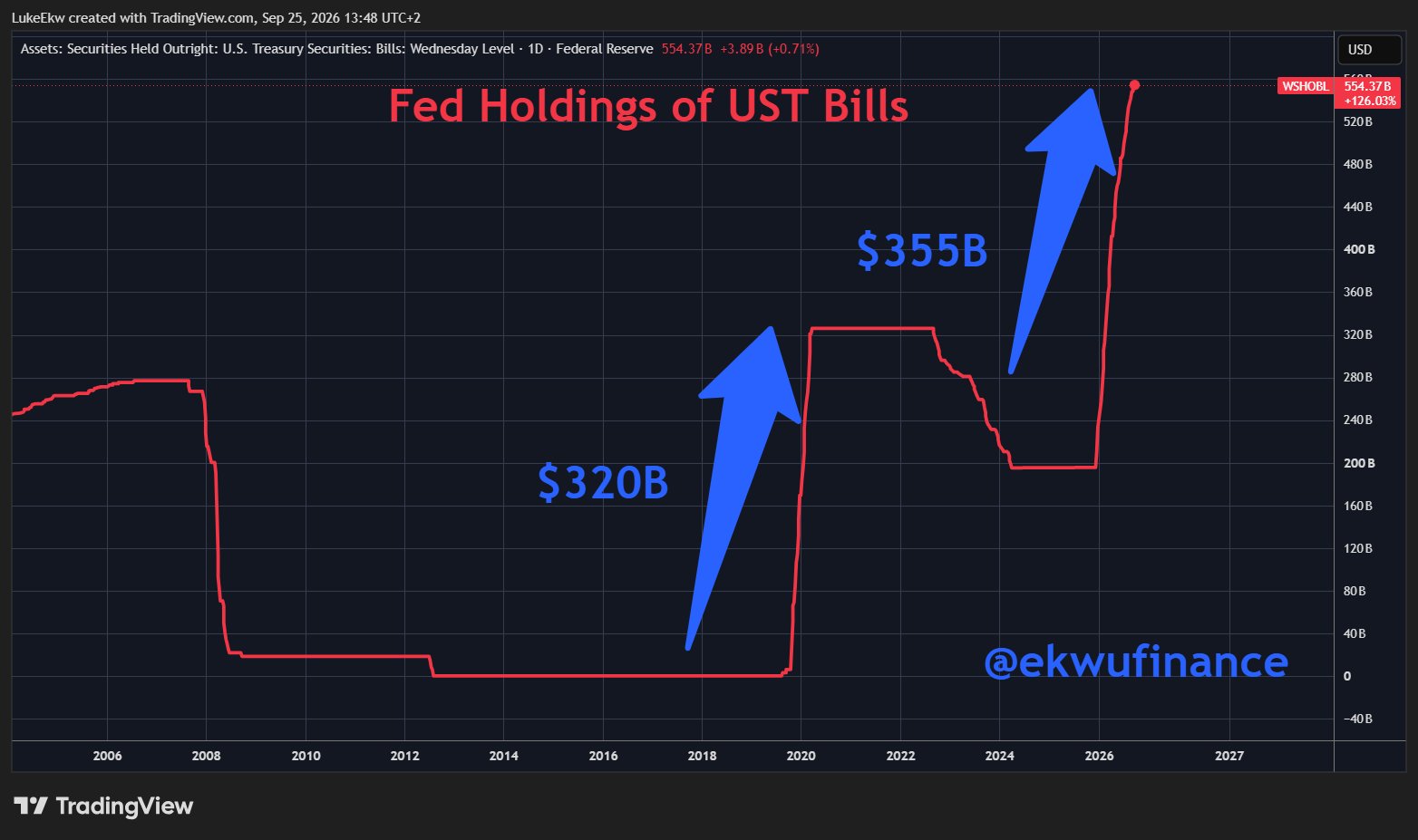
Chart: U.S. Treasury Bills directly owned by the Federal Reserve. As of September 23, 2026, the figure was $554.373 billion. Data source: Federal Reserve H.4.1/TradingView.
In a few months, the curve almost vertically rose from about $200 billion to more than $550 billion.
But it's important to understandwhy fed buys these papers at all.
In December 2025, the FOMC determined that the volume of bank reserves approached a level that the committee considers sufficient to effectively conduct monetary policy. After that, Fed started Reserve Management Purchases.
The New York Fed explicitly states that such purchases increase the size of the Federal Reserve's balance sheet and the amount of reserves in the banking system. Purchases are conducted primarily through Treasury Bills and, if necessary, other Treasuries with a term of up to three years.
In other words, the growth of holdings Treasury Bills is not a random movement of the balance sheet.
This is part of the Fed's new operational phase.
Why is this happening at the same time as the rate hike?
At first glance, there is a contradiction here.
Rate Increaseis usually perceived as a tightening of monetary policy.
Purchase of bonds— as an increase in liquidity.
But these two tools perform different functions today.
On September 16, the FOMC raised the rate to a range of 3.75-4.00%. At the same time, the committee confirmed the policy of maintaining "ample reserves" — a sufficient amount of reserves in the banking system. The FOMC's operating directive specifically states that the New York Fed may increase holdings through Treasury Bills purchases when necessary to maintain a sufficient level of reserves.
Therefore, the growth of the Fed's balance sheet does not in itself mean a transition to a softer monetary policy.
This is a fundamental difference.
The rate answers one question
How expensive is it for banks and the financial system to attract short-term financing?
RMP responds to another
Is there enough reserve in the banking system to allow the Fed to effectively control short-term interest rates?
That is why the Federal Reserve itself emphasizes that Reserve Management Purchases cannot be automatically equated with QE.
Is it QE or not?
This is where the fun starts.
If you only look at the balance, there is indeed a similarity:
Fed buys Treasury → assets Fed grows banking system → reserves increase.
That is why an external observer can see in this the familiar mechanics of creating liquidity.
But classical QE works differently.
During the pandemic, the Fed used large-scale purchases of long-term Treasury and mortgage-backed securities to lower yields and ease financial conditions.
Reserve Management Purchases have a different purpose.
The Federal Reserve explicitly explains that RMPs are designed to maintain ample reserves and effectively control short-term rates. Purchases concentrate on short Treasury Bills rather than large-scale removal of duration risk from the private sector.
Therefore, it is more correct to say as follows:
The mechanics of increasing reserves are similar to QE, but the economic purpose and structure of operations are different.
This is more important than just calling what is happening “QE 2.0”.
How big is the current growth?
Here, the graph is particularly indicative.
According to the official series of the Federal Reserve, Treasury Bills holdings were as follows:
$195.5 billion— December 3, 2025;
$233.6 billion— December 24;
$344.1 billion— March 4, 2026;
$425.2 billion— April 15;
$479.3 billion— June 10;
$524.9 billion— August 5;
$541.995 billion— August 26;
$554.373 billion— September 23.
That is, we are not talking about a single intervention.
Growth occurred almost consistently over several months.
In July 2026, the Federal Reserve itself reported that since the beginning of the year, SOMA has acquired almost $250 billion of Treasury Bills, of which about $160 billion accounted for reserve management purchases, and about $90 billion — for reinvesting principal payments from agency MBS in Treasury Bills.
Thus, the whole dynamic of holdings should not be interpreted as solely “new money printed for the purchase of Treasury”.
Part of the purchases is related to the reinvestment of already existing flows.
And this is where Treasury comes in
Simultaneously with the Fed's operations, the US Treasury Department actively manages the structure of public debt.
In August, Treasury announced an increase in the maximum size of individual repurchase transactions of long-term nominal bonds from $2 billion to at least$4 billion per transaction, starting September 9. We are talking about sectors of 10–20 and 20–30 years.
At the same time, the current Treasury program has two different components:
Liquidity support
Treasury buys off-the-run securities to maintain the liquidity of less actively traded issues.
Cash management
Treasury uses buybacks to manage short-term cash flows and smooth out fluctuations in the size of bill auctions and the Treasury General Account.
For the current quarter, Treasury has provided up to$38 billionliquidity-support buybacks and up to$25 billioncash-management buybacks in the securities segment with a term of one month to two years.
And this already connects the two parts of the story.
Is Treasury Really Cutting Long-Term Debt?
To a certain extent, yes, but an important caveat is needed here.
When Treasury buys back existing long-term bonds, it reduces the amount of specific securities held by the private sector.
But Treasury is simultaneously funding its needs through new releases.
That is why buyback cannot be automatically considered an analogue of QE.
The Federal Ministry of Finance explicitly notes that buybacks alone should not significantly change the volume of net marketable borrowing, since the redeemed securities are replaced by a new issue of debt.
That is, the mechanism rather looks likechange in debt structure and liquidity, rather than the mere disappearance of government debt from the market.
Why is this still important for the bond market?
Because the composition of public debt matters.
Let us present it in a simplified way:
Treasury
long bond → buyback
and at the same time
short bill → issue
As a result, the structure of the sentence changes.
The private sector has fewer long-term issues and more short-term instruments.
This may affect:
structure of profitability;
liquidity of individual issues;
term premium;
dealer demand;
the need of banks and funds for short-term financing;
functioning of the Treasury market.
That's why Treasury is increasing its focus on buybacks.
According to the Treasury itself, over the past two and a half years, almost$500 billiongovernment bonds. About $300 billion of them fell on securities with a maturity of up to two years.
Why does the combination of Fed and Treasury look unusual?
Because two state structures simultaneously work with different sides of the same market.
Fedincreases holdings of short-term Treasuries to maintain a sufficient level of bank reserves.
Treasurymanages its own debt structure using buybacks and new releases.
This is not the same operation.
And there is no reason to automatically combine them into one program.
But for the financial market, both operations are important because they affecttreasury supply structure and liquidity allocation within the financial system.
It is this connection that deserves attention.
What changed after COVID?
Here the historical comparison is really interesting.
During the pandemic, Fed conducted large-scale purchases of long-term Treasury and MBS. The goal was to ease financial conditions and support the economy in the face of extreme shock.
Now the picture is different.
Fed is in modeample reserves, and Reserve Management Purchases are part of the operational infrastructure of monetary policy. The New York Fed separately emphasizes that the current purchases should not be confused with large-scale asset-purchase programs of the COVID period or the Global Financial Crisis.
Therefore, visually, the two episodes may look similar — the balance is growing again.
But the economic reason for growth varies.
The main risk is not only in the volume of purchases
The most interesting part of this story isn't the question of whether Fed is “printing money.”
It is much more important to keep an eye onwhy the need for reserve purchases remains high.
The New York Fed explains that the amount of RMP required depends on at least three factors:
the demand of banks for reserves;
proposals of reserves;
current and expected conditions on money markets.
Reserves are also affected by changes to the Treasury General Account and other Fed liabilities.
For example, TGA growth is able to reduce bank reserves if other conditions remain unchanged. That is why Fed balance management cannot be analyzed separately from Treasury operations.
This makes the Treasury market a kind of bridge between the monetary and fiscal infrastructure of the United States.
What to track now?
1. Holdings Treasury Bills on the Fed balance sheet
This is the main indicator for observation.
If holdings continue to grow rapidly, this means that the need for reserve management purchases remains substantial.
If the pace slows or purchases pause, this may indicate a change in reserve estimates and money market conditions.
2. Treasury General Account
The TGA is essentially the U.S. Treasury's operating account at the Federal Reserve.
Its changes directly affect the distribution of liquidity between the Treasury and the banking system.
The New York Fed indicates that TGA dynamics were one of the factors in changes in reserve conditions in previous periods.
3. SOFR and other repo rates
If the short-term financing market begins to come under pressure, this becomes an important signal for the Fed.
The New York Fed notes that money-market rates, including federal funds rate and Treasury repo rates, are used to assess whether reserves remain within an adequate range.
4. Volumes of Treasury bill issuance
If the Treasury is actively increasing short supply and the Fed is simultaneously buying bills, an important question arises about how quickly the market can absorb the additional supply.
The New York Fed separately noted that a significant volume of net bill issuance in the summer was absorbed by the market without significant pressure on repo rates.
5. Long Treasury yields
This is the other end of the curve.
If Treasury continues to increase buybacks in the long-end, the market will closely monitor how this affects liquidity and prices of long-term issues.
At the same time, Treasury states that the increase in buybacks is primarily due to improved liquidity in the relevant market segments.
6. Fed balance in its entirety
Looking at Treasury Bills alone is not enough.
Important things to consider:
Fed's total assets;
MBS;
Treasury securities;
reserve balances;
Treasury General Account;
ON RRP;
other components of balance.
Only the overall picture allows us to understand whether there is actually a significant change in financial conditions.
Main conclusion
At first glance, today's situation resembles the beginning of a new round of QE.
The Fed has indeed sharply increased its holdings of Treasury Bills: from approx.$195 billion at the beginning of December 2025 to $554 billion by September 23, 2026. This is an increase of almost$359 billion.
But calling it full-fledged QE would be too blunt.
The Federal Reserve itself defines current purchases asReserve Management Purchases. Their official task is to maintain ample reserves and ensure effective control of short-term interest rates.
At the same time, Treasury is expanding its buyback program and actively managing the structure of government debt.There are billions of dollars of buyback activity in the current quarter for both long-term and short-term issues.
Therefore, the main question for the market now is not:
“Has a new QE started?”
It is much more accurate to ask:
“How long will the Fed be forced to increase reserves, how will the structure of Treasury debt change, and what does this mean for the liquidity of the American financial market?”
It is the dynamics of these three factors that may be more important than the loudest number on the chart.
For investors and traders this means one thing:The Fed's balance sheet is once again becoming a metric that cannot be ignored.
Follow key developments in global liquidity, rates and markets withAVORA MARKETS.