
The market began sharply laying the groundwork for a tougher scenario for the Federal Reserve. The likelihood of an interest rate hike at the Fed's September meeting has risen to53%noticeably increased in a short period.
The main trigger was a strong report on the US labor market. August Nonfarm Payrolls showed+162 thousand jobsagainst expectations of about 55 thousand, and the unemployment rate remained at the level of4,1%.
This combination of strong hiring and relatively stable unemployment forces investors to reconsider expectations for the Fed's future actions.
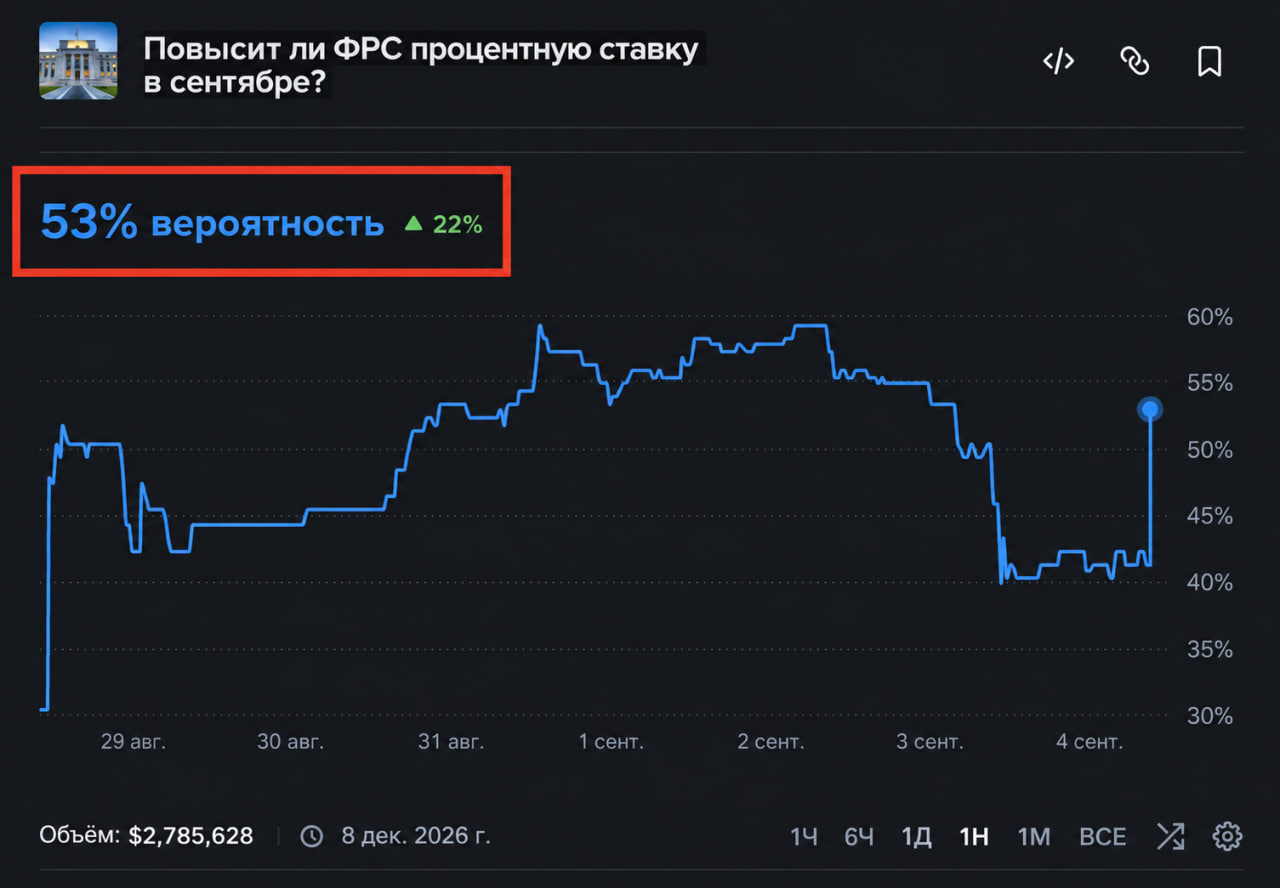
The probability of raising the Fed's interest rate at the September meeting rose to 53%.
Why the market changed expectations
Until recently, the probability of a rate hike was estimated much lower. However, strong employment data forced the market to reconsider the scenario for the next Fed meeting.
For the central bank, the situation is ambiguous. On the one hand, higher employment indicates the preservation of the stability of the economy. On the other hand, a strong labor market can support consumer demand and inflationary pressures.
As a result, there is less room for rapid easing of monetary policy.
What this means for the dollar
Changes in rate expectations usually support the US currency.
If the Fed does move toward tighter policy, U.S. bond yields could remain elevated, increasing the attractiveness of dollar assets.
ThereforeUSD gets an additional fundamental driver for growth, especially if subsequent macroeconomic data continue to point to the resilience of the US economy.
Gold is under pressure
For gold, the situation is less favorable.
Higher interest rates and bond yields raise the opportunity cost of owning assets that do not generate interest income. Therefore, the revision of expectations for the Fed is able to create additional pressure on the precious metal.
At the same time, gold remains sensitive not only to rates, but also to inflation, geopolitical risks and dollar dynamics.
That is why the XAU/USD response can be particularly harsh around the release of new macroeconomic data.
Stock market braces for more volatility
Stocks also receive a less comfortable macroeconomic environment.
High rates increase the cost of capital for companies and put pressure primarily on the most expensive segments of the market, where a significant part of the value is based on future cash flows.
If expectations of a rate hike continue to rise, investors may begin to overestimate risky assets more actively.
This does not automatically mean the start of a massive stock market crash; however,volatility can increase markedly, especially if the next data on inflation and employment turn out to be stronger than expectations.
What will be decisive for the Fed
Now the attention of the market is shifting to the following macroeconomic publications and comments of representatives of the Federal Reserve System.
Particularly important are:
data on inflation;
indicators of the labor market;
dynamics of wages;
consumer demand;
statements by Fed officials.
If the new data confirms the resilience of the economy and the persistence of inflationary pressures, the likelihood of tighter policies may continue to grow.
If the economy begins to noticeably cool, the current jump in expectations for a rate hike may quickly turn back.
Main conclusion
The market has received a new reason to reconsider the scenario of American monetary policy.
The probability of a Fed rate hike in September reached 53%, and a strong labor market report has been a major catalyst for this movement.
For traders, this means a potentially stronger dollar, pressure on gold, and increased stock market volatility.
However, the final decision will depend on the new macroeconomic data.Therefore, the next publications on inflation and the labor market can become key drivers of the movement of USD, gold and American indices.