
You change your strategy after three losses
Sometimes a trader's problem isn't a bad strategy.
The problem is that hedoesn't allow it to work long enough.
Three losing trades in a row — and the familiar scenario is launched automatically: the trader begins to doubt the system, changes filters, removes one indicator, adds another, changes Stop Loss or even switches to a new strategy.
After a few trades, the new system shows a profit.
There is a certainty: "Now I have found a working approach."
And then a few losses — and the cycle starts again.
This is how one of the most expensive trading mistakes appears:constant change of rules instead of sequential execution of one system.
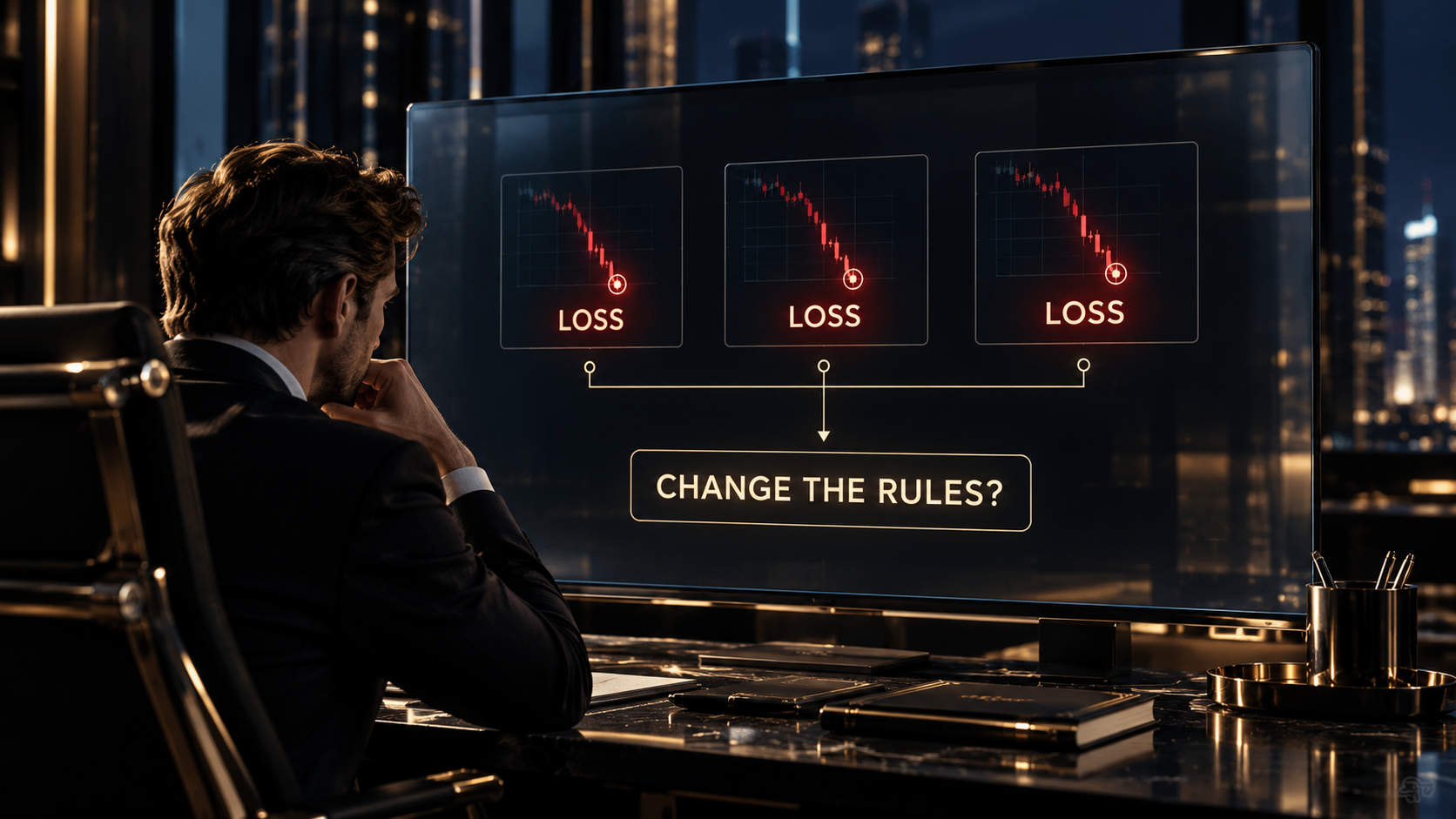
The problem does not start with a loss
The loss itself does not mean that the strategy has stopped working.
For a trader, it often means something quite different:
“I did something wrong.”
This is where the dangerous substitution arises.
The loss turns from a single observation into a conclusion about the entire system.
After that, the trader begins to look for an explanation of what happened.
He looks at the graph no longer in order to test his rules, but to find confirmation of a new hypothesis:
indicator "stopped working";
the market "has become different";
Stop loss "too big";
the entry "you need to do it earlier";
signal "need to be filtered harder".
Each individual change may seem reasonable.
The problem arises when changes occurafter each short period of failure.
Then the system ceases to be a system.
It becomes an ever-changing set of rules.
What this cycle looks like
Imagine a trader who works on the same strategy.
He gets a few losing trades.
Step 1 — Doubt appears
“It looks like the market no longer fits this system.”
Step 2 — the rules change
A trader adds a filter, changes an entry, or excludes a specific type of trade.
Step 3 — Winning trades appear
The new version of the system shows some good results.
The trader makes sure the change was right.
Step 4 — A new series of losses comes in
Now the new system seems to be wrong.
And the trader begins to change it again.
The result is a vicious circle:
LOSS → DOUBT → CHANGE → PROFIT → CONFIDENCE → LOSS → CHANGE
The problem here is not necessarily in a particular strategy.
The problem is the lack of a stable set of rules.
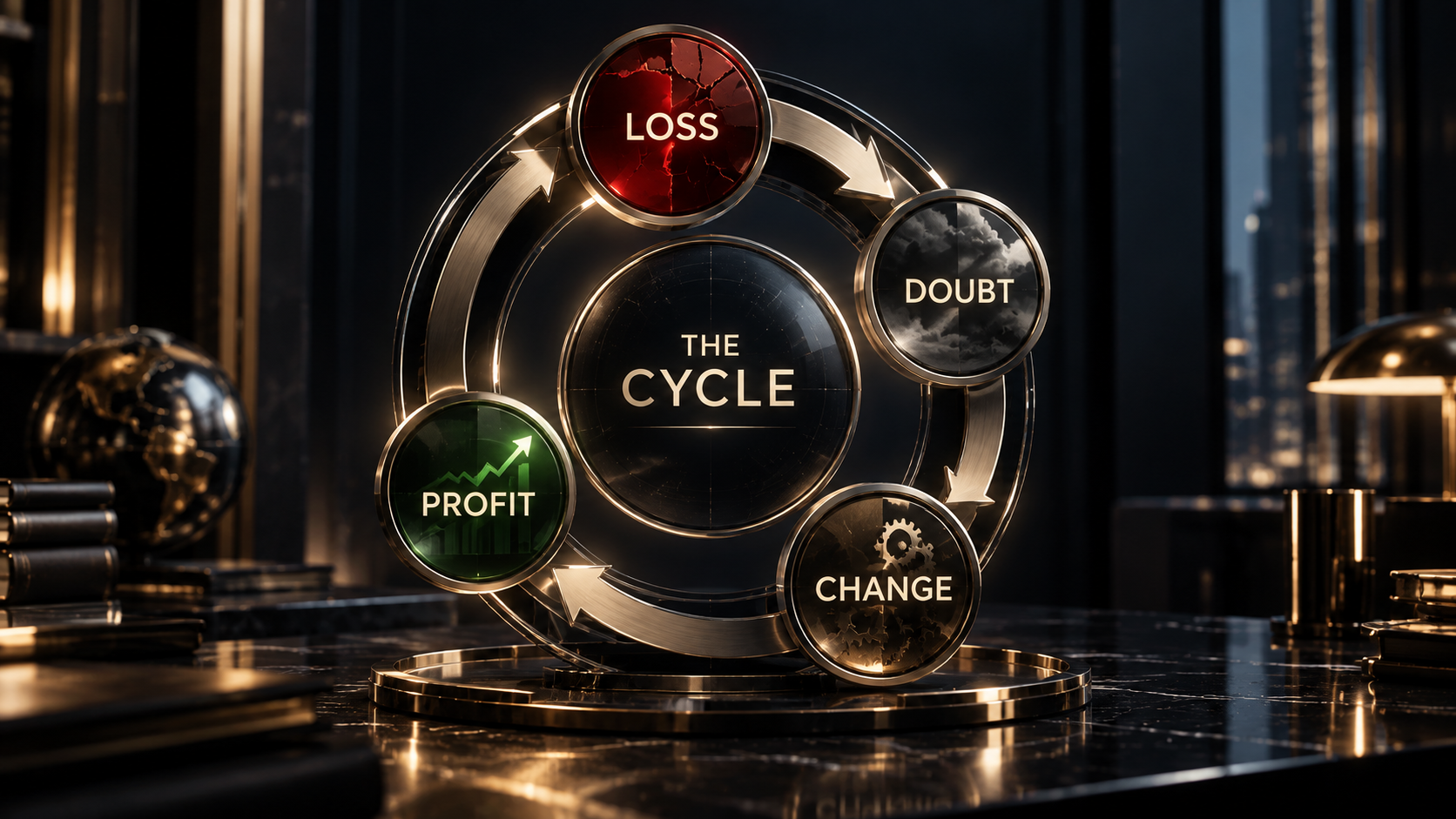
The most dangerous illusion is “I'm improving my strategy”
The constant change of the system is easily mistaken for development.
The trader seems to be getting smarter:
“I found a new pattern.”
“I removed the weak signal.”
“I added a filter.”
“I adapted the system to the market.”
But there is a fundamental difference betweenstrategy improvementandreaction to the latest results.
Improvement begins with analysis.
The reaction begins with an emotion.
If the rule changes because his last few trades were unsuccessful, the trader will actually optimize the system for the recent past.
And the market may already be in a completely different phase.
Therefore, after a series of losses, it is more useful to ask another question:
Have the objective conditions on which the strategy is based changed, or do I just not like its current outcome?
These are two completely different situations.
When does a change in strategy really make sense?
This does not mean that the strategy cannot be changed.
On the contrary, systems must be analyzed and improved.
But change has to happenaccording to a predetermined procedure, rather than following an emotional reaction to multiple trades.
For example, a trader can determine in advance:
what parameters of the strategy are tracked;
which results are considered a deviation;
under what conditions the re-analysis is carried out;
what changes are permissible;
when the new version of the strategy begins to be tested;
how the old and new versions are compared.
Then changing the strategy becomes part of the process.
Not an attempt to urgently "fix" the market after a loss.
What happens when a trader constantly changes the system?
Another problem arises: it becomes impossible to understandwhat exactly brings results.
Present the sequence:
Strategy A → Strategy B → Strategy A.2 → Strategy C → Strategy B.1
Each version was used too little.
Each was changed after a certain result.
And at the end, the trader no longer knows:
which system really has the advantage;
which change was beneficial;
which change worsened the result;
which transactions fall within the same logic;
what results can be compared at all.
This is no longer an analysis.
This is a constant change of hypotheses.
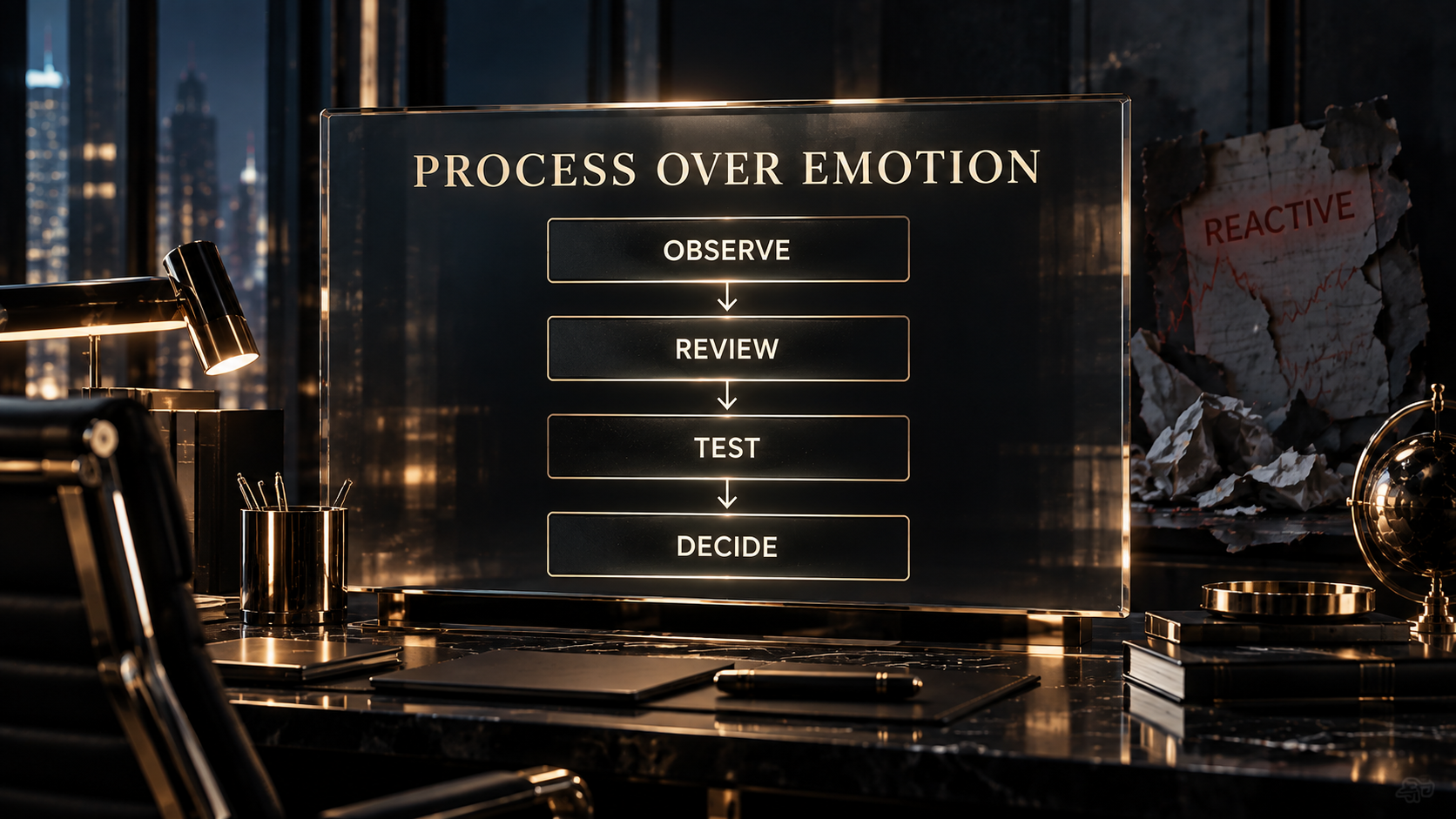
The system should be eligible for unsuccessful trades
One of the most important things in system trading is to accept in advance thata working strategy doesn't have to win every trade.
The strategy may have losing trades.
There may be a series of losses.
There may be periods when its results look worse than usual.
Therefore, before trading, it is important to understand not only:
“What makes me open a position?”
But also:
“What will make me admit that the strategy has really stopped working?”
If there is no answer to the second question, the trader risks making a decision after facing discomfort.
And then the rules begin to dictate not the system, but the emotional reaction.
How not to change strategy after each failure
There is a simple principle:
1. Separate the result of the transaction from the quality of the solution
A losing trade wasn't necessarily a bad decision.
A profitable trade wasn't necessarily a good decision.
It is necessary to evaluate not only P&L, but also whether the transaction complied with the rules of the system.
2. Fix the strategy version
If you changed the rule, fix it.
For example:
Strategy v1.0
then
Strategy v1.1
not the endless “I changed the settings a bit.”
This makes it possible to understand what logic was used at a particular moment.
3. Don't change the rules in the middle of an emotional reaction
If, after a loss, the first wish is to immediately change the indicator, Stop Loss or entry conditions, this is an excuse to stop.
Record the observation first.
Then analyze it.
And only then make a decision.
4. Determine the terms of the revision in advance
The most important decision about strategy is best madebefore there is an emotional need to change something.
Then the trader follows the process, not the last trade.
The main issue after a series of losses
Not:
“How do I change my strategy?”
A:
“What exactly am I seeing right now — proof of a change in the system or just an unpleasant stretch of its results?”
This is a much more complicated question.
But it is this that separates the systematic approach from the constant search for a new strategy.
Because the market doesn't have to validate your system after every trade.
And a trader doesn't have to change it every time the market doesn't.
Main conclusion
Sometimes a trader loses money not because the strategy is bad.
He loses money becausedoes not allow one strategy to live long enough to see its real statistics and behavior in different conditions.
The constant change of rules creates the illusion of control.
It seems that every new change makes the system better.
But if the changes occur solely in response to recent losses, the trader may not improve the strategy, but simply endlessly adapt to the past.
A good system is not a lossless system.
It's a system that hasclear rules, clear terms of review and discipline of execution.
And before you change your strategy after another series of failures, you should ask yourself one question:
“Did I really find a problem in the system — or just don't want to accept a few losing trades?”
Sometimes the difference between these two answers is much more expensive than it seems.