
The Australian dollar falls for 11 days in a row: why the AUD/USD decline may be excessive
The Australian dollar came under serious pressure in the foreign exchange market. The AUD/USD pair ended 11 trading sessions in a row with a decline, and on Friday, November 20, it reached a low of 0.6609. However, analysts at United Overseas Bank (UOB) believe the sell-off is starting to look excessive.
At first glance, the technical picture remains bearish. But after such a long decline, another question arises: how much space remains for sellers and is the market preparing for a short-term recovery?
UOB expects AUD/USD may move into consolidation in the 0.6610-0.6660 range in the near term. At the same time, the medium-term picture still remains negative: consolidation below 0.6610 can open the way to 0.6585.
An interesting situation arises: the downward trend continues, but the potential for further decline is gradually limited.
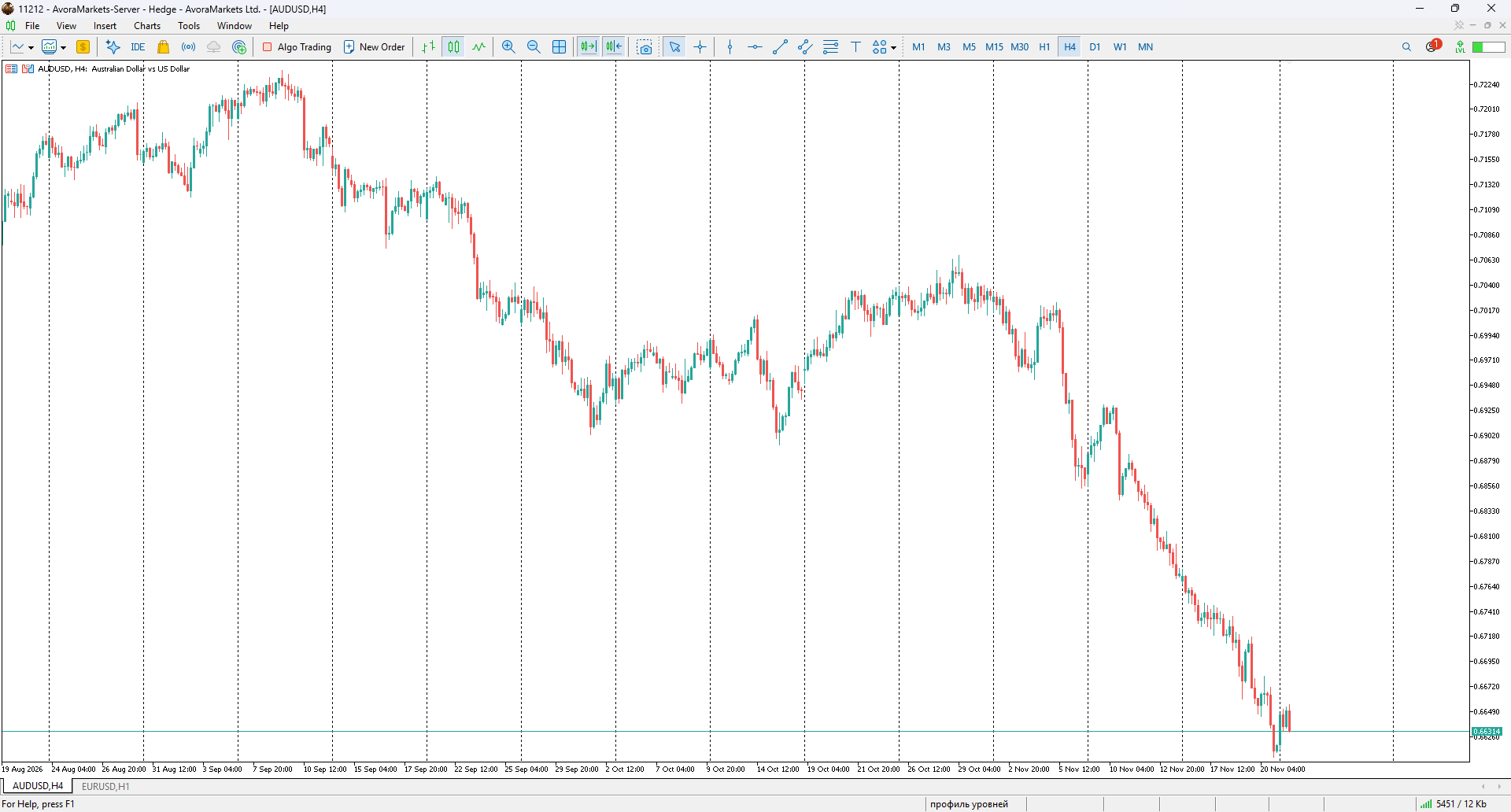
AUD/USD: main figures of the current movement
At the time of analysis, UOB highlights several key indicators:
Last movement low: 0.6609.
Last close on Friday: 0.6617.
Duration of the series of decline: 11 trading sessions.
Expected consolidation range: 0.6610–0.6660.
The next target when the support is broken: 0.6585.
Level that can change the short-term picture: 0.6690.
The main feature of the current situation is not only the scale of the fall, but also its duration. Eleven consecutive sessions of decline is an unusually long streak, which increases the likelihood of a slowdown in downward momentum.
Why has the Australian dollar weakened so sharply?
The current weakness of AUD/USD was influenced by several factors. Among them are the deterioration of Australian employment statistics and a decrease in investor appetite for risk.
Weak Australian labor market data
One of the immediate catalysts for the sale was the October data on the Australian labor market.
According to statistics from the Australian Bureau of Statistics, the number of people employed fell by 43,500 people in a month. Unemployment increased from 4.7% to 4.9%.
This is an important change as the labor market remains one of the key benchmarks for assessing the state of the economy and the Reserve Bank of Australia's (RBA) future policy.
When employment deteriorates, investors begin to take a closer look at the prospects for economic growth and the possibility of further tightening of monetary policy.
This could be a negative factor for the Australian dollar, especially if sentiment in global financial markets worsens at the same time.

Why is the high RBA rate not supporting the currency yet?
An interesting detail is that the Reserve Bank of Australia does not have a loose monetary policy.
On November 3, 2026, the RBA raised its key interest rate by 0.25 percentage points to 4.85%.
However, the Australian currency continued to weaken.
This shows why the interest rate alone does not determine the direction of a currency pair.
Market participants evaluate not only the current value of money, but also the prospects for further decisions of the central bank, the state of the economy and the difference in expectations relative to other countries.
If economic data begins to deteriorate, the previous support for the currency from high rates may not be enough.
In addition, the foreign exchange market takes into account the decisions of the US Federal Reserve. Therefore, for AUD/USD, not only the position of the RBA is important, but also the relative attractiveness of the US dollar.
Global decline in risk appetite
The Australian dollar has traditionally been a risk-sensitive currency.
This means that when sentiment in financial markets deteriorates, the AUD often comes under additional pressure.
Unlike the Japanese yen and Swiss franc, which often receive support during periods of uncertainty, the Australian currency is more dependent on expectations for economic growth, international trade and commodity demand.
Global stock markets suffered broad declines last week, with investors trimming positions in riskier assets.
This situation could increase pressure on the Australian dollar and accelerate its decline against the USD.
Why does UOB think the fall in AUD/USD is excessive?
The main message from UOB analysts is that the direction of movement and the potential for further movement are not the same thing.
Since the beginning of the month, the bank has maintained a negative view on the Australian dollar. However, the rate of decline was higher than initial expectations.
On November 20, the pair reached 0.6609 and ended the day around 0.6617, losing 0.62%.
At the same time, the series of declines has already reached 11 consecutive trading sessions.
For analysts, this was a sign that the downward movement may be overextended.
It is important to understand the difference between the two concepts here:
Bearish trend- the price continues to form lower highs and lows.
Oversold- the speed and scale of the decline become so significant that the likelihood of short-term stabilization increases.
Oversold does not mean an automatic reversal. The price may continue to decline even after a long series of negative sessions.
But she warns that opening new positions following an existing move can be significantly riskier.
This is why UOB now expects consolidation rather than an immediate continuation of the sharp decline.
AUD/USD forecast: what levels are important now?
The UOB analysis highlights several price targets that can determine the further dynamics of the pair.
Support 0.6610
This is the nearest key level for the market.
As long as the price remains above 0.6610, UOB does not expect the sharp decline to automatically continue.
In the short term, the bank is considering consolidation in the range of 0.6610–0.6660.
If buyers are able to hold the lower limit of this range, selling pressure may gradually ease.
Level 0.6585
This is the next potential target if the decline continues.
However, for such a scenario to develop, AUD/USD needs to consolidate below 0.6610.
At the same time, UOB emphasizes that even if a breakout occurs, further downside potential may remain limited due to the already formed oversold situation.
Resistance 0.6660
The upper limit of the expected short-term range.
A price return above this area would indicate a gradual recovery from prolonged pressure.
However, for a more convincing signal of a change in downward dynamics, the following benchmark must be overcome.
Level 0.6690
The most important level in the current UOB assessment.
According to analysts, a break of 0.6690 would be a sign that the Australian dollar is no longer continuing to decline.
This does not mean an automatic transition to a full-fledged uptrend, but will be an important confirmation of the easing of selling pressure.
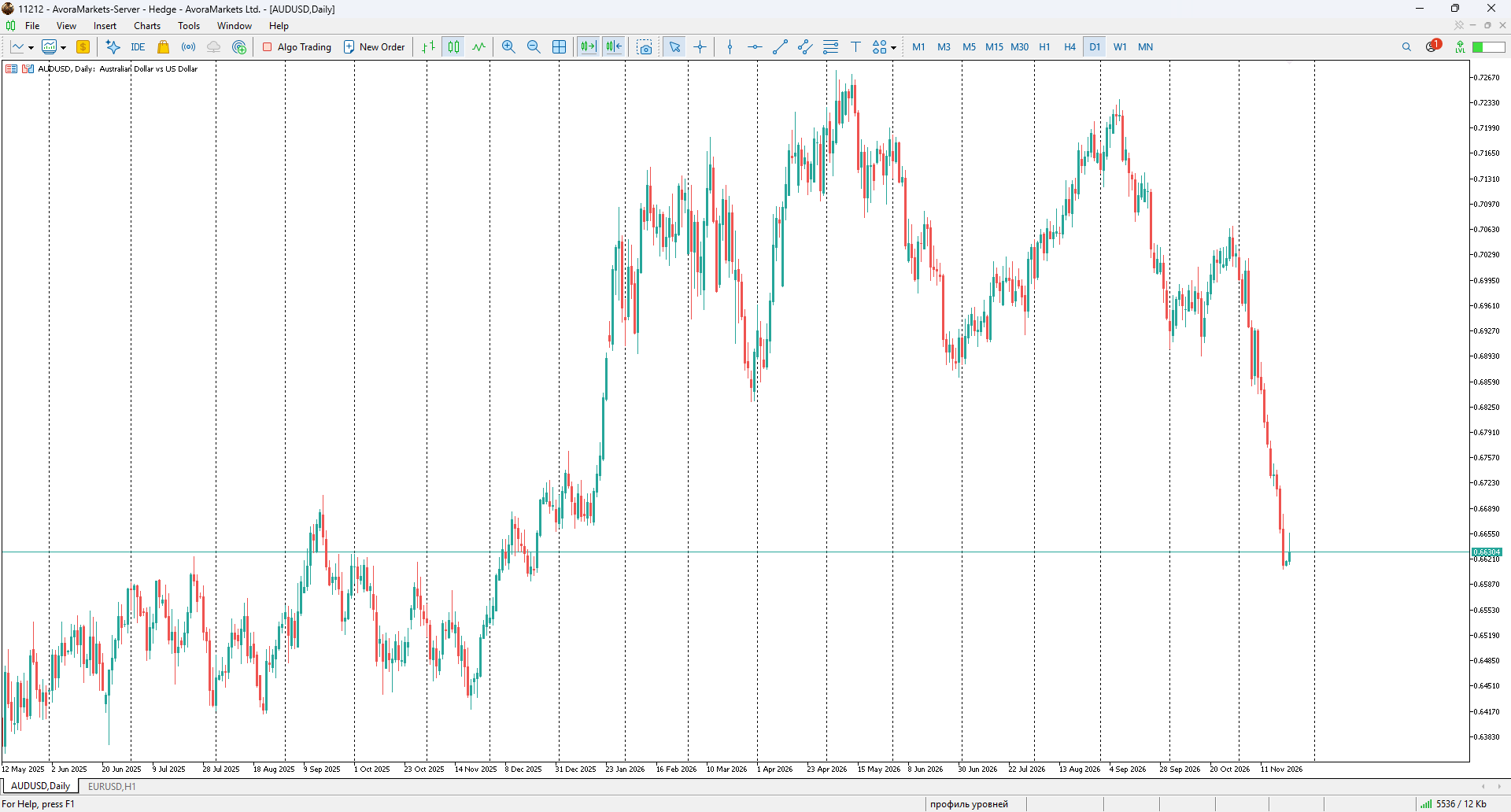
Three scenarios for further movement of AUD/USD
The current situation allows us to identify three main scenarios.
1. Consolidation - UOB base short-term scenario
After 11 consecutive sessions of decline, the market may move sideways.
In this case, the pair will fluctuate mainly between 0.6610 and 0.6660.
This scenario will allow the market to partially compensate for the excessive decline and form a new short-term structure.
2. Continued fall to 0.6585
If sellers can achieve a close below 0.6610, the likelihood of further declines will increase.
The next target will be 0.6585.
However, even in this scenario, UOB estimates the potential for further weakening to be limited.
3. Recovery above 0.6690
If buyers are able to push AUD/USD back above 0.6690, it will indicate that the current bearish phase may be ending.
In this case, the market’s attention will switch to the sustainability of the recovery and the ability of the price to form higher local lows.
Additional technical and fundamental information will be required to confirm a full trend reversal.
What will determine the further movement of the Australian dollar?
There are several factors to keep an eye on in the coming weeks.
1. Australian labor market statistics
A further deterioration in employment could increase doubts about the outlook for the Australian economy and put pressure on the AUD.
2. Decisions of the Reserve Bank of Australia
After the rate is raised to 4.85%, the market will evaluate further signals from the regulator. Tougher rhetoric could support the Australian dollar, while softening expectations could limit its recovery.
3. Dynamics of the US dollar
AUD/USD remains sensitive to changes in the USD exchange rate. Therefore, it is important to monitor the DXY dollar index and expectations regarding Fed policy.
4. Global investor sentiment
With intensifying sell-offs in stock markets, the Australian currency may experience additional pressure. The return of risk appetite, on the contrary, can support the AUD.
5. Price reaction to 0.6610 and 0.6690
These two marks will help assess whether selling pressure continues or whether the market is beginning to stabilize.
Key takeaway: The Australian dollar may be approaching its downside limit
AUD/USD finds itself in an unusual situation. Eleven consecutive sessions of decline and a fresh low to 0.6609 indicate a serious dominance of sellers.
However, UOB analysts believe the current move is becoming excessive. Therefore, instead of immediately continuing the sell-off, they expect consolidation in the range of 0.6610–0.6660.
However, the medium-term downside risk remains.A close below 0.6610 could open the way to 0.6585, but even this scenario is seen by analysts as having limited potential.
The main mark for assessing changes in short-term dynamics is 0.6690.
That is why it is now important not just to follow the downward movement, but to evaluate how much potential it still retains.
Trade AUD/USD with AVORA MARKETS
Open a trading account and use analytical tools to build your own trading strategy.